Christian branding doesn’t make a Christian company.
A cross on the logo and a Bible verse on the website do not make a company Christian. Across America, businesses market themselves as “Christian” or “pro-life” to attract faith-based customers, yet many of these same organizations quietly route their profits and vendor relationships through companies that fund abortion access, LGBTQ+ advocacy, and causes that directly oppose biblical teaching. The result is a marketplace full of Christian-branded companies that function as secular businesses wearing a cross. Customers feel virtuous using their services, believing their money supports Kingdom work, when in reality they are simply buying the owners bigger homes and nicer cars while their processing fees subsidize the very causes they claim to oppose. If Christian payment companies are not making hard decisions to stand on the truth of scripture—if they are supporting Christian and anti-Christian causes simultaneously—then what good are they?
There is an alternative. Pro-Life Payments is a Christian payment company that donates 15% of its gross revenue to pro-life ministries—not as a marketing gimmick, but as a structural, first-fruits commitment built into the foundation of the business. That distinction between branding and business model is everything.
The Problem With Christian Payment Companies in Name Only
The phrase “Christian payment companies” has become a marketing category more than a moral commitment. Put the following search term into your search engine, “Pro-Life Alternative to [Your Payment Company Name].” A growing number of businesses claim Christian identity to capture faith-based market share, yet their operational decisions tell a different story. As the Pro-Life Payments blog documents, organizations that publicly proclaim Christian values have come under scrutiny for utilizing services from companies that actively promote abortion access, transgender services, and LGBTQ+ issues. The ethical dissonance is glaring: a company brands itself as Christian to win your trust and your transactions, but it processes those transactions through partners whose corporate policies fund the opposite of what Christians believe.
This is not an abstract theological debate. It is a question of financial stewardship. Every dollar that flows through a payment processor generates fees, and those fees become revenue for the processor. When that processor offers abortion travel benefits to employees, funds gender-affirming surgeries, or underwrites organizations like Planned Parenthood, Christian customers are unwittingly subsidizing the culture of death with every swipe. A “Christian” label on the front end does not redeem what happens on the back end. The branding reassures the customer; the business model serves the world.
Must See Also: Christian Companies, Non-Christian Choices
Why Christian Payment Companies Must Go Beyond Branding
Scripture does not leave room for half-measures. Jesus warned in Matthew 6:24 that no one can serve two masters—”either you will hate the one and love the other, or you will be devoted to the one and despise the other.” Christian payment companies that try to serve both a faith-based customer base and a secular corporate agenda are attempting precisely what Christ said was impossible. They offer customers the comfort of Christian branding while making business decisions indistinguishable from any secular competitor.
Consider what it means for a company to call itself “Christian” and then partner with processors like PayPal, Stripe, or Square. PayPal, the owner of Venmo, is a signatory to the U.N. Women’s Generation Equality Forum, which actively supports removing legal barriers to abortion access worldwide. Block, the owner of Square and CashApp, covers voluntary abortions and short-term disability for gender-affirming surgeries as reported in its 2022 Corporate Social Responsibility Report. When a “Christian” payment company routes its transactions through these providers, the Christian brand becomes a mask over a secular machine.
The test for any Christian payment company is straightforward: are you making hard decisions that cost you something, or are you simply capitalizing on the Christian market? If a company’s operational decisions mirror those of every secular competitor—same processors, same vendor relationships, same corporate policies—then the Christian branding is decoration, not identity.
Must See Also: Payments Industry Values Incompatible with Christian, Pro-Life Values
The Chick-fil-A Warning for Christian Payment Companies
No company better illustrates the danger of Christian branding without Christian conviction than Chick-fil-A. For years, conservative Christians championed the fast-food chain as a beacon of faith-driven business. Its Sunday closures and donations to organizations like the Fellowship of Christian Athletes and the Salvation Army made it a symbol of corporate Christianity. Then, in 2019, Chick-fil-A announced it would end donations to the Salvation Army and the Fellowship of Christian Athletes—both organizations that had stood firm on biblical sexual morality—in response to LGBTQ pressure campaigns.
Chick-fil-A CEO Dan Cathy later admitted in a letter to the American Family Association that the chain had “inadvertently discredited” the very faith-based organizations it once supported. The company had reaped years of loyalty from Christians who believed their chicken sandwich dollars were advancing the Kingdom. When the cultural pressure became costly, the company retreated. The brand stayed “Christian” in the public imagination, but the business decisions shifted to accommodate the secular mainstream.
This is the cautionary tale for every Christian payment company. The brand earns the loyalty; the business decisions reveal the loyalty’s true object. Christian consumers must stop asking, “Does this company call itself Christian?” and start asking, “Is this company making decisions that cost it something for the sake of Christ?”
Must See Also: The Top 5 Reasons Christians Should Switch to Pro-Life Payments

What Customers Actually Fund Through Christian Payment Companies
Most customers of Christian payment companies never ask where their processing fees go. They assume the Christian label means their money stays within the faith-based ecosystem. The reality, as Pro-Life Payments has documented extensively, is that processing fees from mainstream processors flow into corporate treasuries that fund abortion travel benefits, DEI initiatives, pride campaigns, and donations to organizations fundamentally opposed to Christianity.
The American Life League’s Charity Watchlist identified more than two dozen charities—including organizations with ostensibly Christian identities—that maintain ties to pro-abortion and LGBTQ advocacy. If charities operating under the Christian banner cannot be trusted to align their spending with their stated beliefs, why would payment companies be any different?
When a Christian-branded payment company processes $1 million in annual transactions through a secular processor, the downstream effects are measurable. The company collects fees from Christian customers, pays a portion of those fees to processors whose corporate policies underwrite abortion access, and pockets the difference. The customer sees a Christian logo. The money sees a secular pipeline. The pro-life movement sees nothing.
Must See Also: Pro-Life Payment Solutions: Why It Matters Where Your Processing Fees Go
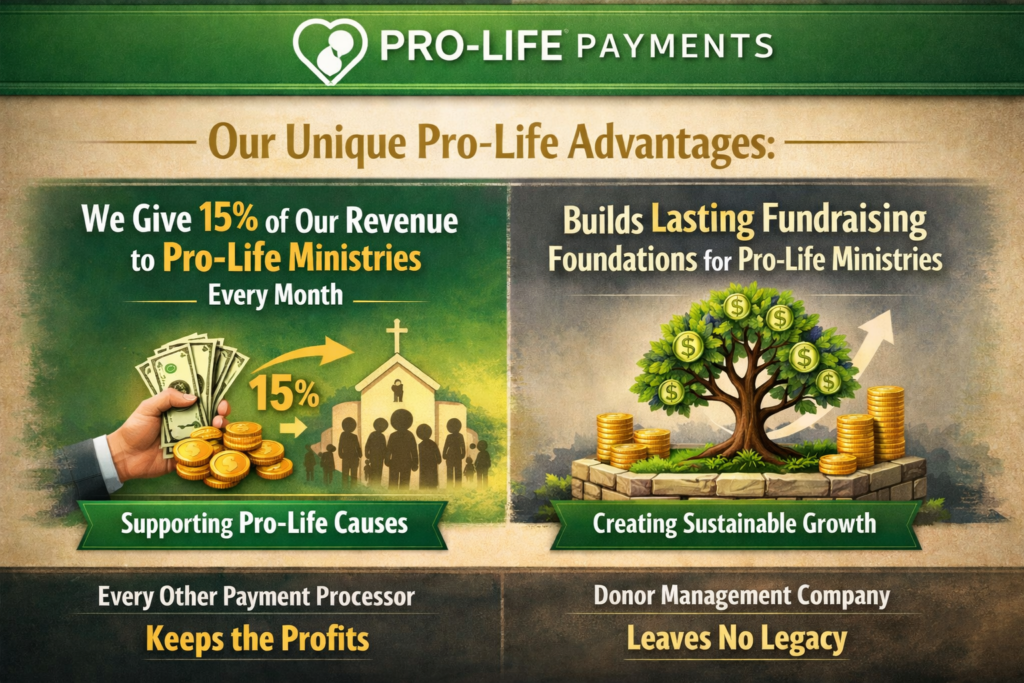
How Pro-Life Payments Redefines What Christian Payment Companies Should Be
Pro-Life Payments exists because its founder discovered that mainstream payment processors were actively funding abortion and anti-Christian causes. Rather than slapping a Christian label onto a secular business model, the company was built from the ground up with a first-fruits commitment: 15% of gross revenue goes directly to pro-life organizations that provide ultrasounds, counseling, material support, and alternatives to abortion for women in crisis pregnancies.
This is not profit-sharing, which can be manipulated through accounting. It is revenue-sharing—fixed, transparent, and verifiable. For every dollar Pro-Life Payments collects in processing fees, fifteen cents goes directly to ministries saving babies. The company’s processing fees constitute approximately 1% of the gross revenue processed by its business customers. That means a business processing $500,000 annually generates roughly $5,000 in processing fees for Pro-Life Payments, of which $750 is donated to pro-life ministries—automatically, without the business owner writing a separate check or organizing a fundraiser.
Pro-Life Payments offers the full suite of services that compete directly with secular alternatives: e-commerce and omni-channel payment processing, retail and restaurant POS systems, mobile card readers, ACH payments, donation management tools, free equipment and POS rentals, month-to-month contracts with no early termination fees, and next-day or same-day funding. Christian businesses sacrifice nothing in capability or performance. What they gain is the certainty that every transaction advances life instead of funding its destruction.
Must See Also: Christian Merchant Services: Pro-Life Payments Company Profile

Christian Payment Companies and the Stewardship of Every Transaction
The conversation about Christian payment companies ultimately comes down to stewardship. Scripture teaches that believers are stewards of every resource God entrusts to them—including the operational expenses of their businesses. Research on Christian businesses reveals that 40–60% of revenue flows to vendors, suppliers, and service providers. For a $1 million business, that represents $400,000 to $600,000 in annual vendor spending. Where that money goes is a stewardship question every bit as significant as tithing.
Pro-Life Payments transforms this stewardship equation. Rather than sending processing fees into the coffers of companies that bankroll Planned Parenthood and pride campaigns, Christian businesses can ensure their financial transactions align with their values. If 1,000 Christian businesses each processing $200,000 annually switched to Pro-Life Payments, the collective volume would generate approximately $2,000 in annual net fees per business ($200,000 × 1%). Pro-Life Payments would then donate 15% of those fees—resulting in $300 per business, or $300,000 in total annual funding directed to pro-life ministries. That is the equivalent of a $300,000 grant to pregnancy resource centers, funded entirely by redirected processing fees and requiring no additional donations, campaigns, or administrative overhead.
This is what it looks like when a Christian payment company operates by conviction rather than branding. The money doesn’t build mansions for owners pretending to be Christian. It builds a culture of life.
Must See Also: The Ultimate Guide to Christian Merchant Services
Christian Payment Companies and the Cancel Culture Threat
Beyond the question of values alignment, there is a practical reason Christian businesses need payment companies with genuine conviction. Mainstream processors have frozen accounts, closed services, and deplatformed Christian organizations for expressing biblical positions on life, marriage, and sexuality. High-profile cases abound: Stripe cut off Gab.com, PayPal has terminated accounts of conservative voices, and Christian ministries have found themselves suddenly unable to process donations because their worldview offended a secular platform’s corporate policy.
A Christian-branded payment company that relies on secular infrastructure cannot protect its customers from this threat. When the upstream processor decides a client’s biblical stance is “hate speech,” the Christian branding downstream provides zero protection. Pro-Life Payments was founded specifically to serve the faith community and openly rejects ideological deplatforming. For Christian organizations, this means the confidence that standing firm on scripture will not result in losing the ability to process transactions overnight.
The difference between a genuinely Christian payment company and a Christian-branded secular company becomes most visible under pressure. When culture demands compromise, does the company bend or hold? Branding bends. Conviction holds.
Must See Also: Can Christians Dominate the Payments Industry?
Choosing a Christian Payment Company That Matches Your Convictions
For Christian business owners and ministry leaders evaluating Christian payment companies, the vetting process should go beyond logos and mission statements. Ask these questions:
-
Where do the processing fees go? If the company processes through PayPal, Stripe, Square, or Block, your fees are subsidizing abortion access and LGBTQ activism regardless of what the front-facing brand says.
-
Does the company donate to pro-life causes? If so, how much, how often, and from what—profit or revenue? A company that donates from profit can manipulate the number to near zero. A company that donates from gross revenue, as Pro-Life Payments does at 15%, puts its money where its mission statement is.
-
Is the company making decisions that cost it something? Giving away 15% of gross revenue is expensive. It means smaller margins, slower growth, and real sacrifice. That is the cost of conviction. A company making no costly decisions for the sake of Christ is not a Christian company—it is a secular company with a Christian tagline.
-
Does the company protect Christian customers from deplatforming? If the company cannot guarantee uninterrupted service regardless of cultural pressure on biblical positions, it is not serving the Christian community—it is profiting from it.
Pro-Life Payments passes every one of these tests. It provides world-class Christian merchant processing services comparable to any secular competitor while structurally funding the pro-life movement with every transaction. No other payment company in the industry makes this commitment.
Must See Also: A Viable Faith-Based Alternative to Stripe
The Call to Action for Christian Payment Companies and Their Customers
Christian payment companies must decide what they are: ministries with merchant accounts, or merchants with ministry branding. The difference determines whether the Christian community is strengthened or exploited. Customers who use these services must hold them accountable—not to the design of their website, but to the direction of their dollars.
Pro-Life Payments stands as proof that a payment company can be authentically Christian in both brand and business model. It donates 15% of its gross revenue to organizations protecting the unborn, offers industry-competitive features including e-commerce integration, donation management, POS systems, and next-day funding, and refuses to route Christian dollars through processors that fund the destruction of innocent life. Every transaction processed through Pro-Life Payments is a transaction redeemed for Kingdom purposes.
The question for every Christian business owner, pastor, and ministry leader is simple: is your payment company Christian because of a label, or because of what it does? If you cannot answer with certainty that your processing fees are funding life instead of death, it is time to make the switch. Christian branding doesn’t make a Christian company. Christian decisions do—and those decisions start with where your money goes.
Must See Also: Pro Life Fintech – Pro-Life Payments