
Every Sunday morning, pastors across America proclaim from their pulpits the sanctity of human life and the moral imperative to protect the unborn. Congregations stand in affirmation, donate to pregnancy resource centers, and proudly identify as pro-life communities. Yet come Monday morning, when those same churches process tithes and offerings through mainstream payment processors, they unknowingly route thousands of dollars annually to corporations that fund Planned Parenthood, abortion travel benefits, and organizations actively lobbying to expand abortion access.

This cognitive dissonance represents one of the most significant—and most overlooked—contradictions in contemporary Christian witness. Churches vote pro-life daily not merely through sermon content or political advocacy, but through institutional financial decisions that either amplify or undermine their stated mission. Payment processing fees, vendor contracts, banking relationships, and service agreements collectively represent hundreds of thousands or even millions of dollars flowing from church budgets into the broader economy. The question is not whether churches will make these payments—operational expenses are unavoidable—but whether those payments will fund the culture of death or the culture of life.
The thesis is straightforward yet sobering: Churches vote pro-life daily through institutional financial decisions and can exponentially amplify pro-life impact by ensuring congregational finances never fund abortion-expanding corporations. This principle extends beyond payment processing to encompass every vendor relationship, every service contract, and every financial partnership. When churches align their financial infrastructure with their pro-life mission, they transform unavoidable operational expenses into perpetual funding streams for pregnancy resource centers, adoption agencies, and life-affirming ministries. When they fail to audit these relationships, they become unwitting financial supporters of the very organizations they oppose from the pulpit.

The stewardship imperative demands that church leaders—pastors, administrators, finance committee members, treasurers, and governing boards—exercise the same level of scrutiny over institutional vendor relationships that they would apply to investment portfolios or major capital expenditures. Fiduciary responsibility to the congregation requires ensuring that church resources advance rather than contradict the church’s mission. For churches that claim pro-life convictions as central to their identity, this responsibility includes guaranteeing that payment processors, banks, insurance providers, and other service vendors share—or at minimum do not actively oppose—those convictions.
Must See Also: The Best Christian and Pro-Life Investments to Consider in Today’s Market
The Stewardship Imperative: Why Churches Must Vote Pro-Life Daily with Every Transaction
Biblical stewardship encompasses far more than responsible budgeting or generous giving. Scripture consistently teaches that believers serve as managers—not owners—of resources entrusted to them by God, and that faithful management requires examining not merely how much is spent but where those expenditures ultimately flow. The Parable of the Talents (Matthew 25:14-30) emphasizes that servants receive reward not for preservation but for multiplication—for actively deploying resources in ways that advance the master’s purposes. Proverbs 3:9-10 instructs believers to honor the Lord with firstfruits, dedicating resources at the beginning of economic activity rather than offering only surplus after personal needs are satisfied.

Church leaders who oversee congregational finances carry fiduciary responsibility that extends beyond secular legal obligations to encompass theological accountability. This responsibility includes three interconnected duties that shape how churches vote pro-life daily through vendor selection. The duty of care requires church leaders to exercise reasonable diligence when making financial decisions, conducting thorough research and analysis to ensure vendor relationships align with congregational mission and values. The duty of loyalty demands that leaders act in the church’s best interests, avoiding conflicts that could compromise mission integrity. The duty of obedience requires adherence to the church’s stated mission and the faithful execution of donor intent.
Applied to payment processing and vendor selection, these duties create clear expectations. Finance committees cannot simply accept the default option—typically mainstream processors like PayPal, Stripe, or Square—without investigating whether those processors’ corporate activities contradict the church’s pro-life mission. Research documents that major payment processors donate millions of dollars to organizations including Planned Parenthood and the ACLU specifically to fight pro-life legislation. PayPal offers abortion travel benefits to employees and has publicly supported “reproductive rights” advocacy. When churches route their payment processing through these corporations, they effectively subsidize abortion advocacy with congregant donations—a direct violation of fiduciary duty to ensure church resources advance church mission.
The financial scale magnifies the stewardship urgency. A growing church processing two million dollars annually in tithes and donations through a standard 2.5% processing fee pays fifty thousand dollars in annual fees. Even a fraction of that sum—redirected by the payment processor to abortion advocacy organizations—represents thousands of dollars that donors intended for Kingdom purposes being diverted to fund the destruction of human life. Over a decade, that single line item in the church budget could generate half a million dollars in fees, a substantial portion of which funds causes directly opposed to the church’s stated values. Faithful stewardship demands churches audit where these fees flow and redirect them toward vendors whose values align with congregational mission.
Churches that vote pro-life daily through vendor selection demonstrate what Pro-Life Payments describes as “front-to-back alignment”—operational consistency where every element of organizational infrastructure actively advances rather than contradicts stated mission. This alignment honors donor intent by ensuring contributions support only life-affirming activities. It protects congregational witness by preventing the hypocrisy of opposing abortion publicly while funding it privately. And it fulfills the biblical mandate for integrity, ensuring that the church’s financial transactions reflect rather than betray its theological convictions.
Must See Also: Christian Merchant Processing
How Payment Processors Quietly Undermine Churches That Vote Pro-Life Daily
Most church administrators and finance committee members remain entirely unaware that their payment processors actively fund abortion advocacy. The disconnect is understandable—payment processing appears to be a neutral utility service, comparable to electricity or water. Churches select processors based on competitive rates, technological capabilities, and ease of integration, rarely investigating the corporate values or political activities of processor leadership. This ignorance, however well-intentioned, creates a destructive pattern: pro-life churches unknowingly route money to abortion providers and advocacy groups through payment processing infrastructure they never scrutinized for values alignment.
The major payment processors dominating church giving platforms—PayPal, Stripe, Square, Braintree, and their various subsidiary brands—maintain documented track records of supporting abortion access and progressive social causes that conflict with biblical Christianity. PayPal, which processes donations for thousands of churches through its Giving Fund and various integrations, signed corporate letters supporting the removal of legal barriers to abortion. The company offers employees up to $10,000 in travel reimbursement for abortion procedures, a benefit PayPal publicly defended as essential to “reproductive healthcare.” Venmo, PayPal’s peer-to-peer payment subsidiary often used for church small groups and ministry teams, operates under the same corporate policies and executive leadership.
Stripe, another dominant processor in church e-commerce and giving platforms, donated substantial sums to the ACLU specifically designated for fighting state-level pro-life legislation. The ACLU actively litigates against pro-life laws, advocates for unlimited abortion access through all nine months of pregnancy, and opposes conscience protections for healthcare workers who object to participating in abortions. When churches process donations through Stripe, they fund an organization working systematically to expand abortion access and eliminate legal protections for the unborn. Square, owned by Block Inc., maintains similar corporate commitments to “reproductive rights” and LGBTQ+ advocacy, directing corporate resources and charitable giving toward organizations opposing biblical sexuality and marriage.
The financial mechanics of how churches vote pro-life daily—or vote against life—through payment processing warrant closer examination. Payment processors typically charge between 2.0% and 3.5% per transaction plus a small per-transaction fee. For a church processing $100,000 monthly in tithes and online giving, standard 2.9% + $0.30 fees generate approximately $35,000 in annual processor revenue. Payment processors use this revenue for operational expenses, executive compensation, corporate expansion, and—critically for pro-life churches—charitable giving and political advocacy.
Major payment processors donate millions annually to organizations including Planned Parenthood, NARAL Pro-Choice America, the Human Rights Campaign, and various LGBTQ+ advocacy groups. They fund corporate PACs supporting pro-abortion political candidates. They provide employee benefits specifically subsidizing abortion procedures. And they direct corporate matching gifts toward “reproductive justice” organizations working to expand abortion access. When pro-life churches route their payment processing through these corporations, they become unwitting financial supporters of abortion advocacy—their processing fees transformed into donations to organizations they would never support directly.
The ideological deplatforming risk compounds the values misalignment concern. Payment processors have demonstrated increasing willingness to terminate accounts based on customers’ political or religious views. Conservative nonprofits, Christian ministries, and pro-life organizations have experienced sudden account closures, frozen funds, and service terminations—often without warning or clear explanation. The pattern reveals that mainstream processors view pro-life convictions as potentially incompatible with their corporate values, creating operational risk for churches that depend on these processors for essential financial infrastructure.
Must See Also: Tithing to Planned Parenthood with Every Swipe: How Your Payment Processor Funds Abortion
Auditing Your Church’s Financial Infrastructure to Vote Pro-Life Daily
Church leaders committed to ensuring their congregations vote pro-life daily through financial infrastructure must conduct systematic audits across all vendor relationships, beginning with payment processing but extending to banking, insurance, investment management, and operational service providers. This audit process follows established principles of church financial accountability while adding a values-alignment dimension that many churches have historically overlooked. The goal is not to achieve absolute perfection—which remains impossible in a fallen economy—but to ensure that churches make informed, intentional decisions about where their operational expenses flow and actively redirect resources toward vendors that share rather than oppose congregational values.
The payment processing audit forms the natural starting point because processing fees represent substantial, recurring expenses that flow directly from every donation and every financial transaction. Finance committees should begin by identifying all current payment processing relationships: the primary processor for Sunday morning offerings and online giving, any secondary processors for specific ministries or events, peer-to-peer platforms used by small groups, and e-commerce solutions for church bookstores or resource sales. For each processor, committees must document the total annual fees paid, the processor’s corporate ownership structure, and publicly available information about the processor’s charitable giving, employee benefits, and political advocacy.
Values compatibility research requires examining whether processors or their parent companies have taken public positions on abortion, sexuality, marriage, or religious liberty that contradict church teaching. This research should include reviewing corporate social responsibility statements, ESG (Environmental, Social, Governance) reports, employee benefits packages, and public statements by executive leadership. Many processors explicitly incorporate United Nations definitions of “reproductive health” and “human rights” that identify abortion access as a fundamental right, creating immediate values conflicts with pro-life congregations. Others donate corporate funds or provide matching gifts to organizations including Planned Parenthood, NARAL, or abortion advocacy groups.
The banking relationship audit follows similar methodology. Churches should examine where they maintain checking accounts, savings reserves, and any endowment or investment funds. Major national banks—including Bank of America, Wells Fargo, Citibank, and JPMorgan Chase—maintain documented track records of funding Planned Parenthood, offering abortion travel benefits to employees, and donating to organizations opposing religious liberty protections. Community banks and credit unions often provide more values-neutral alternatives, though even these institutions require examination of their corporate charitable giving and policy positions. Faith-based financial institutions designed specifically to serve Christian organizations represent the strongest alignment option, though availability varies by region.
Insurance and benefits providers constitute another critical audit category. Many churches maintain property and casualty insurance, directors and officers liability coverage, and employee benefits packages including health insurance and retirement plans. National insurance carriers frequently incorporate diversity, equity, and inclusion mandates that promote progressive social causes, and health insurance plans may cover elective abortions or provide abortion travel benefits. Churches seeking values alignment should investigate whether their insurance providers fund abortion advocacy, maintain explicit pro-life exclusions in coverage, and share the church’s theological convictions about life and sexuality.
The vendor audit should extend systematically to all recurring service contracts: accounting and bookkeeping services, legal counsel, marketing and communications firms, facility maintenance contractors, audio-visual equipment suppliers, and technology platforms including website hosting, church management software, and email marketing services. For each category, finance committees should identify whether faith-aligned alternatives exist and whether current vendors maintain values compatibility with church mission. The audit question is straightforward: Does this vendor share our pro-life convictions, or does this vendor actively oppose those convictions through corporate giving, employee benefits, or political advocacy?
Documentation and accountability require that finance committees maintain written records of values alignment research, present findings to church leadership, and develop transition plans for vendor relationships that fail values alignment standards. This documentation protects against congregational criticism, provides continuity when committee membership changes, and demonstrates fiduciary diligence in stewarding church resources. Churches should adopt written policies specifying that vendor selection includes values compatibility assessment and that the church will preferentially select vendors whose corporate activities support rather than contradict church mission.
Must See Also: How to Start Biblically Responsible Investing in 7 Simple Steps
Vote Pro-Life Daily: Practical Steps for Transitioning Payment Processors
Churches that complete vendor audits and identify values misalignment with current payment processors face the practical challenge of transitioning to faith-aligned alternatives without disrupting giving, frustrating congregants, or compromising financial operations. The good news is that modern payment processing technology makes transitions far simpler than many church leaders assume. Most faith-aligned processors—including Pro-Life Payments, which specializes in serving churches and nonprofits—provide comprehensive migration support, competitive rates matching or beating mainstream processors, and full-featured platforms that rival the technological sophistication of larger competitors.
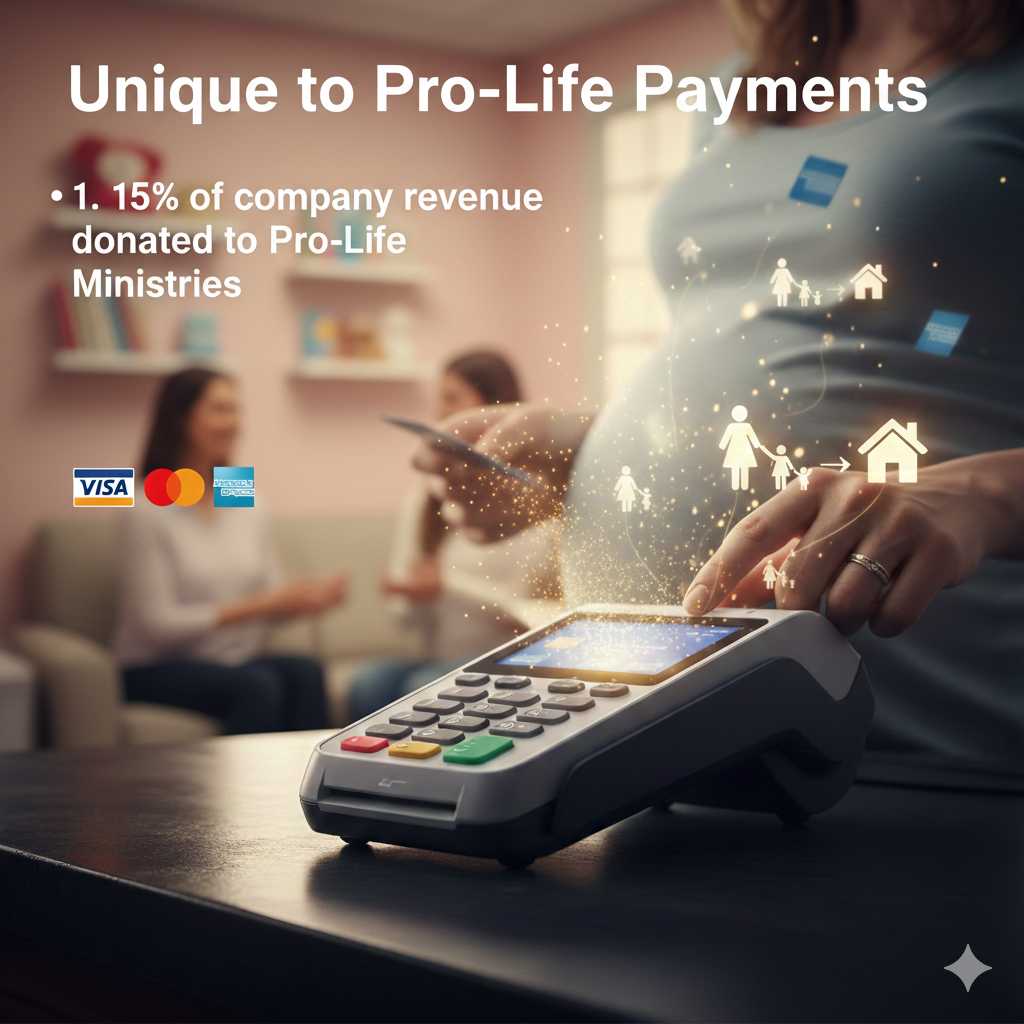
The transition process begins with selecting a values-aligned payment processor that serves churches effectively. Pro-Life Payments exemplifies the ideal alternative: founded explicitly to serve pro-life organizations, the company commits 15% of gross revenue—not net profit, but total revenue received—to pregnancy resource centers and life-affirming ministries. This means that when a church processes donations through Pro-Life Payments, approximately 15 cents of every dollar in processing fees flows directly to organizations protecting unborn life. The business model transforms unavoidable operational expenses into automatic, perpetual pro-life funding without requiring churches to allocate additional budget resources or conduct special fundraising campaigns.
Pro-Life Payments offers comprehensive services specifically designed for churches: Pro-Life Prosper donation management software integrating with church management systems, online giving platforms supporting one-time and recurring donations, mobile payment solutions for events and missions, retail point-of-sale systems for bookstores and cafes, and e-commerce integrations for churches selling resources online. The company provides competitive processing rates typically ranging from 2.3% to 2.9% depending on transaction volume and payment types, month-to-month contracts with no early termination fees, free equipment rentals eliminating upfront capital expenditure, and next-day or same-day funding ensuring consistent cash flow.
The technical migration typically requires four to six weeks from initial application to full implementation, though emergency transitions can occur more rapidly. Churches should begin by contacting Pro-Life Payments to discuss their current processing volume, payment types (in-person vs. online, credit cards vs. ACH), and any specialized needs including recurring giving management, designated fund tracking, or integration with specific church management software. Pro-Life Payments conducts a straightforward underwriting process—501(c)(3) churches typically receive approval within 20 minutes—and provides detailed implementation support including equipment configuration, website integration, and staff training.
The parallel operation phase allows churches to minimize disruption during transition. Rather than immediately replacing all payment systems, churches can phase the transition by starting with online giving platforms while maintaining existing in-person systems temporarily, or by launching Pro-Life Payments for new initiatives like capital campaigns while legacy systems continue for weekly offerings. This gradual approach allows staff and congregants to become comfortable with new systems before complete migration occurs, reducing the risk of technical problems disrupting giving.
Communication strategy proves critical for successful transitions. Finance committees and pastoral leadership should proactively explain to congregations why the church is transitioning payment processors, emphasizing values alignment and the pro-life funding impact. Many churches report that congregants respond enthusiastically when they learn their donations will no longer fund abortion-supporting corporations and will instead generate automatic contributions to pregnancy resource centers. Churches can incorporate the processor transition into broader stewardship teaching, helping congregants understand that faithful giving includes ensuring their gifts flow through values-aligned infrastructure.
The cost comparison typically reveals that transitioning to Pro-Life Payments involves no financial penalty and often results in cost savings. Churches paying 2.9% + $0.30 per transaction through mainstream processors can typically match or improve those rates with Pro-Life Payments while gaining the added benefit of knowing their fees fund life-affirming work. For a church processing $100,000 monthly at standard rates, the processing fees total approximately $35,000 annually regardless of processor selection—the only difference is whether those fees fund Planned Parenthood or fund pregnancy resource centers. The transition cost is zero, the ongoing cost is comparable or better, and the missional impact is transformative.
Must See Also: The Ultimate Credit Card Processing Solution for Churches
How Churches Can Recommend Pro-Life Vendors and Vote Pro-Life Daily to Congregants
Churches that transition their institutional financial infrastructure to vote pro-life daily create opportunities to extend values alignment throughout their congregations by recommending faith-aligned vendors to church members for personal and business use. This ecosystem approach multiplies pro-life impact exponentially: rather than only the church’s operational expenses supporting life-affirming causes, every transaction by every congregant can generate pro-life funding when individuals and business owners within the congregation adopt values-aligned vendors for their personal finances and commercial operations.
Pastoral leadership possesses unique influence to shape congregational financial decisions through teaching, example, and resource provision. Sermons addressing biblical stewardship naturally incorporate discussion of values alignment in vendor selection, helping congregants understand that faithfulness extends beyond how much they give to include where their spending and business operations direct resources. Church leaders can frame values-aligned vendor selection not as legalistic requirement but as discipleship opportunity—a practical application of bringing every area of life under Christ’s lordship, including financial infrastructure that most Christians never examine critically.
The church business directory provides a practical tool for connecting congregants with values-aligned vendors across all categories. Many churches maintain informal referral networks where members recommend contractors, service providers, and professionals to one another. Formalizing these networks into curated directories—available through church websites, member portals, or printed resource guides—allows leadership to vet vendors for both quality and values alignment before recommending them to congregants. For payment processing, churches can actively recommend that business owners within the congregation transition to Pro-Life Payments, explaining the same rationale that motivated the church’s institutional transition: processing fees represent unavoidable business expenses, and directing those fees to values-aligned processors ensures they fund life-affirming causes rather than abortion advocacy.
The pro-life impact scales dramatically when churches successfully encourage business owners within their congregations to adopt faith-aligned payment processing. A church with 200 families may include 30 to 50 business owners or self-employed professionals who process customer payments, employee benefits, or vendor transactions. If even half of those business owners transition to Pro-Life Payments, the collective pro-life funding impact dwarfs what the church generates through its own operations. A congregation where ten small businesses each process $20,000 monthly generates $200,000 in monthly transaction volume—approximately $60,000 in annual processing fees at standard rates, of which $9,000 (15% of the revenue Pro-Life Payments receives) flows to pregnancy resource centers when businesses use values-aligned processing.
Christian business owners operating retail stores, restaurants, professional services firms, e-commerce businesses, or contracting companies process substantial annual transaction volumes that translate into significant payment processing fees. Most business owners selected their current processor years ago based on convenience or recommendation from their accountant, and most have never revisited that decision to assess values alignment. Church-based education and recommendation provides the catalyst many Christian business owners need to examine their payment processing critically and transition to faith-aligned alternatives.
The congregational recommendation strategy should emphasize practical benefits alongside missional impact. Pro-Life Payments offers competitive rates, modern technology including mobile readers and e-commerce integrations, month-to-month contracts providing flexibility, and full customer support—making the transition practically frictionless while delivering the values alignment business owners desire. Churches can provide Pro-Life Payments contact information, facilitate introductory meetings between business owners and Pro-Life Payments representatives, and celebrate publicly when congregation members make the transition—reinforcing that values-aligned financial decisions represent commendable discipleship rather than burdensome legalism.
Churches can extend the vendor recommendation principle beyond payment processing to encompass banking, insurance, professional services, and operational vendors. Developing relationships with Christian accountants, attorneys, insurance agents, and financial planners who serve church members creates referral networks where values alignment becomes normalized expectation rather than unusual exception. Over time, this approach builds what Pro-Life Payments describes as “ecosystem transformation”—a self-reinforcing network where Christian individuals and organizations primarily transact with other Christians who share their values, ensuring that economic activity within the faith community supports Kingdom purposes rather than funding opposition to biblical principles.
Must See Also: Attracting Pro-Life Customers by Aligning Your Payment Processing with Your Values
The Cost Comparison: Churches Can Vote Pro-Life Daily Without Financial Sacrifice
One of the most persistent myths preventing churches from transitioning to values-aligned payment processors is the assumption that faith-based alternatives must be more expensive, less sophisticated, or operationally inferior to mainstream processors. Church finance committees conditioned to prioritize cost minimization often hesitate to investigate alternatives, fearing that values alignment comes at the price of higher fees, inferior technology, or reduced functionality. The reality contradicts these assumptions: Pro-Life Payments and similar faith-aligned processors offer competitive pricing matching or beating mainstream alternatives while providing comparable or superior technology, customer service, and specialized features designed specifically for churches and nonprofits.
The pricing comparison begins with transaction rates, which mainstream processors typically structure as a percentage plus per-transaction fee. PayPal charges 2.89% + $0.49 for online donations to nonprofits, though rates increase for certain transaction types. Stripe standard nonprofit rates start at 2.9% + $0.30 per transaction. Square quotes 2.6% + $0.10 for card-present transactions and 2.9% + $0.30 for online transactions. These rates appear competitive until churches recognize that every dollar in fees flows to corporations actively funding abortion advocacy and progressive political causes.
Pro-Life Payments offers pricing typically ranging from 2.3% to 2.9% depending on monthly processing volume, transaction types, and whether churches accept cards in-person, online, or through multiple channels. For churches processing substantial monthly volumes—$50,000 or more—rates often fall at the lower end of this range, matching or beating mainstream processor pricing. Critically, Pro-Life Payments operates on month-to-month contracts with no early termination fees, eliminating the contractual lock-in that some processors use to trap customers in unfavorable terms. Churches can evaluate Pro-Life Payments risk-free, knowing they retain flexibility to adjust if circumstances change.
The total cost analysis extends beyond transaction rates to encompass equipment costs, monthly fees, statement fees, chargeback fees, and other charges that can substantially increase the effective cost of payment processing. Many mainstream processors require equipment purchases or leases, charge monthly gateway fees, impose minimum monthly processing requirements, or assess penalty fees for low-volume months. Pro-Life Payments eliminates many of these ancillary charges by offering free equipment rentals rather than purchases, no monthly minimums, no statement fees, and transparent pricing that includes all standard features without hidden charges.
The functional comparison reveals that values-aligned processors provide sophisticated technology rivaling mainstream alternatives. Pro-Life Prosper, the donation management platform designed specifically for churches and nonprofits, offers online giving pages with customizable branding, recurring donation management for sustained stewardship, donor management tools tracking giving history and communication preferences, integration with popular church management software including Planning Center and Church Community Builder, mobile-responsive design ensuring functionality across devices, and analytics dashboards providing real-time insights into giving trends. These features match or exceed what mainstream processors provide, while adding values alignment that mainstream alternatives cannot offer.
The stewardship calculation reveals that even if Pro-Life Payments charged marginally higher rates—which it typically does not—the pro-life funding impact would justify the differential. A church processing $100,000 monthly through a mainstream processor at 2.7% pays $32,400 annually in fees, none of which supports pro-life causes and some of which funds abortion advocacy. The same church processing through Pro-Life Payments at 2.7% pays identical fees, but approximately $4,860 (15% of the gross revenue Pro-Life Payments receives, calculated as 15% of the ~1% net fees retained after interchange) flows to pregnancy resource centers. The economic analysis is straightforward: identical cost, exponentially superior missional outcome.
The opportunity cost framework shifts perspective from “Can we afford to switch?” to “Can we afford not to switch?” Churches continuing to process through mainstream abortion-supporting processors effectively donate thousands of dollars annually to organizations working to expand abortion access. Transitioning to Pro-Life Payments redirects those same unavoidable fees toward pregnancy resource centers without increasing total expenses. The decision involves zero marginal cost—churches will pay processing fees regardless of processor selection—while generating substantial pro-life funding impact through intentional vendor selection.
Must See Also: Aligning Your Business with Your Values: Pro-Life Payment Solutions
Communicating Values Alignment: How to Explain Why Your Church Votes Pro-Life Daily
Church leaders who transition their congregations’ financial infrastructure to vote pro-life daily must communicate this decision effectively to ensure congregational understanding, support, and participation. Financial transparency represents a fundamental principle of church stewardship, requiring that leadership openly explain financial decisions and invite congregational engagement in the church’s fiscal life. Transitioning payment processors to achieve values alignment provides an exceptional opportunity to teach biblical stewardship principles while demonstrating institutional integrity and strengthening congregational confidence in leadership.
The communication strategy should begin before the transition occurs, with pastoral leadership and finance committees explaining to the congregation why vendor selection matters for church witness and mission integrity. Sunday announcements, newsletter articles, website posts, and special stewardship teaching sessions can introduce the concept that faithful stewardship includes ensuring church operational expenses support rather than contradict church mission. Leaders should explain clearly and factually—without sensationalism—that major payment processors donate to organizations including Planned Parenthood and actively support abortion access through corporate policies and political advocacy.
The positive framing emphasizes what the church is moving toward rather than only what it is moving away from. Rather than merely criticizing mainstream processors, communication should celebrate the opportunity to transform unavoidable operational expenses into perpetual pro-life funding. Church leaders can explain that switching to Pro-Life Payments means every donation processed—every tithe, every online gift, every capital campaign contribution—automatically generates funding for pregnancy resource centers and life-affirming ministries. This reframing shifts the narrative from sacrifice or compromise to multiplication and kingdom impact.
Quantifying the expected impact helps congregants understand the concrete implications of voting pro-life daily through vendor selection. Finance committees can calculate and communicate projections: “Based on our current giving trends, switching to Pro-Life Payments will generate approximately $3,000 annually in donations to pregnancy resource centers, equivalent to providing free ultrasounds for 30 women considering abortion.” This quantification makes abstract values alignment concrete and measurable, allowing congregants to see that institutional financial decisions carry real-world consequences for unborn lives.
The testimony and storytelling approach personalizes the values alignment message by connecting payment processing decisions to actual people and actual babies saved. Churches can invite representatives from local pregnancy resource centers to share stories of mothers who chose life because they received support from centers funded partly through Pro-Life Payments donations. These testimonies transform payment processing from dry administrative topic to life-and-death ministry opportunity, helping congregants understand that their giving includes not only the donation amount but the infrastructure through which that donation flows.
Addressing potential concerns proactively demonstrates leadership competence and builds congregational confidence. Some members may worry that transitioning processors will disrupt recurring giving, compromise security, increase costs, or create technical problems. Church leaders should address these concerns directly: explaining the migration process and timeline, documenting that Pro-Life Payments offers comparable pricing and superior values alignment, highlighting the security features and PCI compliance that protect donor information, and providing customer service contacts for members who encounter technical questions. Transparency about both benefits and potential temporary inconveniences builds trust and prepares congregations for realistic expectations.
The ongoing communication maintains momentum after the initial transition by regularly celebrating the pro-life impact generated through values-aligned payment processing. Churches can include quarterly or annual reports documenting how much pro-life funding the church’s payment processing generated, how many babies were estimated saved through that funding based on pregnancy resource center conversion rates, and specific stories of mothers and babies served by organizations receiving Pro-Life Payments donations. This ongoing communication reinforces that voting pro-life daily through financial infrastructure represents not a one-time decision but a sustained discipleship commitment producing measurable Kingdom impact.
Must See Also: Why Pro-Life Businesses Need to Rethink Their Payment Processors
The Exponential Impact When Churches Vote Pro-Life Daily
The true power of churches voting pro-life daily through financial infrastructure alignment emerges not from individual congregational decisions but from the exponential multiplication that occurs when churches influence their congregants, congregants influence their businesses, and the faith community collectively redirects billions of dollars in economic activity toward values-aligned vendors. This ecosystem approach transforms payment processing from isolated administrative function to strategic lever for funding the pro-life movement at scale while simultaneously building economic resilience within the Christian community.
The mathematical progression illustrates the multiplication principle. A single church processing $100,000 monthly through Pro-Life Payments generates approximately $1,500 annually in pro-life funding (15% of the ~$10,000 in net processing fees Pro-Life Payments receives from $1.2 million in annual transaction volume). This represents meaningful impact—roughly equivalent to providing free pregnancy tests, counseling, and ultrasounds for 15 women considering abortion. The impact remains localized to that congregation’s operational expenses unless the church extends values alignment teaching to congregants.
When that same church successfully encourages ten business owners within the congregation to transition their commercial payment processing to Pro-Life Payments, the pro-life funding impact multiplies substantially. If those ten businesses collectively process $500,000 monthly in customer transactions—a conservative estimate for businesses including restaurants, retail stores, professional services, and contractors—they generate approximately $7,500 annually in pro-life funding through their payment processing. Combined with the church’s institutional giving, the total pro-life funding reaches $9,000 annually, equivalent to services for 90 women facing unplanned pregnancies. The multiplication factor is sixfold, achieved through church recommendation and congregational adoption rather than additional budget allocation.
The network effects accelerate as values-aligned vendor adoption spreads throughout the congregation. Business owners who transition to Pro-Life Payments often recommend the processor to other business owners in their professional networks, creating viral adoption beyond the church’s direct influence. Congregants who learn about values alignment in payment processing frequently apply the same principle to banking, insurance, and other financial relationships, redirecting additional resources toward faith-aligned alternatives. This creates what economists describe as “virtuous cycle dynamics”—each incremental adoption makes subsequent adoptions easier and more valuable, generating self-reinforcing momentum.
The denominational and network multiplication represents the highest tier of exponential impact. When churches share their values-alignment experiences with other congregations—through denominational conferences, pastoral networks, church planting networks, or simply informal relationships—the exponential potential reaches unprecedented scale. A denomination with 500 congregations that collectively adopts Pro-Life Payments for institutional processing would generate approximately $750,000 annually in pro-life funding simply from church operational expenses. If those same 500 congregations successfully influence business owners within their communities to adopt values-aligned processing, the total pro-life funding could exceed $3 million annually—equivalent to the operational budgets of multiple regional pregnancy resource centers.
The funding sustainability transforms pro-life resource center economics from donation-dependent volatility to transaction-driven stability. Traditional pregnancy center fundraising operates through annual campaigns, major donor cultivation, and event-based revenue—all subject to economic downturns, donor fatigue, and unpredictable giving patterns. The Pro-Life Payments model creates annuity-like income that grows automatically as transaction volume increases, requires no active fundraising or donor stewardship beyond the initial processor adoption, scales proportionally with economic growth, and continues indefinitely as long as businesses process transactions. This revenue reliability allows pregnancy centers to plan strategically, hire staff, expand services, and invest in capital improvements rather than operating hand-to-mouth dependent on volatile donor behavior.
The cultural witness dimension extends beyond quantifiable funding impact to encompass the church’s public testimony about values consistency. Churches that vote pro-life daily through financial infrastructure alignment demonstrate that pro-life commitment encompasses more than Sunday sermons or political advocacy—it extends into every operational decision and financial relationship. This integrated witness refutes the common criticism that pro-life Christians care only about birth rather than supporting mothers and families comprehensively. When churches ensure their operational expenses fund pregnancy support rather than abortion advocacy, they embody holistic pro-life commitment that addresses both legal restrictions and practical support simultaneously.
Must See Also: Pro-Life Christian Investing: How to Let Your Portfolio Speak Up for the Unborn
Conclusion: Your Church’s Daily Pro-Life Vote Begins Now
Every financial decision a church makes represents a vote—a concrete expression of values, priorities, and ultimate allegiance. These votes accumulate daily through countless transactions: Sunday offerings processed through payment platforms, vendor invoices paid through banking systems, insurance premiums flowing to national carriers, investment returns generated through portfolio managers. The question confronting every church leader is not whether their congregation will vote through these financial decisions—voting is unavoidable—but whether those votes will align with or contradict the church’s stated mission and theological convictions.
For churches that claim pro-life identity as central to their faith witness, the imperative is clear: institutional financial infrastructure must align with pro-life mission, ensuring that operational expenses support rather than undermine the church’s commitment to protecting unborn life. This alignment requires systematic auditing of payment processors, banking relationships, insurance providers, and vendor contracts to identify where church resources currently flow and whether those destinations share the church’s values. It demands intentional transition to faith-aligned alternatives that direct unavoidable operational expenses toward life-affirming causes rather than abortion advocacy. And it invites churches to extend values alignment teaching throughout their congregations, multiplying pro-life impact exponentially as individual members and business owners adopt the same principles in their personal finances and commercial operations.
The practical pathway forward is straightforward and immediately accessible. Church finance committees can contact Pro-Life Payments today to initiate conversation about transitioning institutional payment processing to a platform that commits 15% of gross revenue to pregnancy resource centers and life-affirming ministries. The application process for 501(c)(3) churches typically completes within 20 minutes, implementation occurs within four to six weeks, and ongoing operations match or exceed the functionality churches currently experience with mainstream processors—while ensuring that every transaction generates pro-life funding rather than subsidizing abortion advocacy.
Church leaders can schedule values alignment audits for banking, insurance, and vendor relationships, systematically identifying opportunities to redirect operational expenses toward faith-aligned alternatives. They can develop congregational education initiatives teaching biblical stewardship principles that include values alignment in financial decision-making. They can create church business directories connecting congregants with values-aligned vendors across all service categories. And they can share their experiences with other churches through denominational networks, pastoral relationships, and public testimony, catalyzing broader adoption throughout the Christian community.
The stewardship accountability is both immediate and eternal. Church leaders stand before God responsible for how they managed resources entrusted to their care, including whether they exercised diligence to ensure those resources advanced Kingdom purposes rather than funding opposition to God’s design for human life. Congregants entrust their tithes and offerings to church leadership with the expectation that those gifts will support ministry consistent with biblical values. When churches route those offerings through payment processors that fund Planned Parenthood, they violate that sacred trust and compromise their witness.
The opportunity before the American church is unprecedented. If even ten percent of evangelical and Catholic congregations transitioned their payment processing to Pro-Life Payments, the collective pro-life funding impact would exceed $30 million annually—enough to fully fund operational expenses for hundreds of pregnancy resource centers nationwide, provide free ultrasounds for hundreds of thousands of women considering abortion, and fundamentally transform the resource landscape for life-affirming ministries. This represents achievable, practical impact requiring no additional budget allocation, no special fundraising campaigns, and no sacrifice of operational functionality—merely intentional vendor selection that directs unavoidable expenses toward values-aligned alternatives.
Your church’s daily pro-life vote begins with a single decision: to audit current payment processing relationships, investigate faith-aligned alternatives, and commit to ensuring that every transaction processed through church financial infrastructure supports rather than contradicts the pro-life mission. That decision cascades into exponential impact as congregants adopt similar practices, business owners redirect commercial processing, and churches throughout denominational networks follow your example. The first step is simple. The impact is transformative. The calling is clear.
Vote pro-life daily. Align your church’s financial infrastructure with your pro-life mission. Contact Pro-Life Payments today and transform unavoidable operational expenses into perpetual funding for the protection of unborn life.
Must See Also: Pro-Life Christian Accountant Power