
Thesis: Does Webconnex Share Christian, Pro-Life Values?
In today’s value-conscious marketplace, faith-based organizations, ministries, and Christian-owned businesses are increasingly scrutinizing the companies they partner with—not just for functionality, but for moral alignment. Payment processors, donation platforms, and event software are no longer just operational tools; they are extensions of an organization’s mission. This research report examines Webconnex—the parent company behind GivingFuel, TicketSpice, RegFox, and RedPodium—and investigates whether the company shares Christian, pro-life values. For organizations seeking Christian alternatives to Webconnex, understanding the company’s leadership, corporate positions, and affiliations is essential before entrusting them with ministry dollars.

Webconnex’s Stance on Abortion: What Christians Need to Know
When searching for Christian alternatives to Webconnex, the question of where the company stands on abortion is paramount for pro-life organizations. The research reveals a critical finding: Webconnex has made no public corporate statement on abortion—neither for nor against.
The company’s terms of service and public-facing materials contain no language addressing abortion, pro-life causes, or reproductive rights. Unlike mainstream payment processors such as PayPal, Stripe, and Square—which actively offer abortion travel benefits to employees—Webconnex has not publicly disclosed any such employee benefits or corporate donations related to abortion access.
However, the absence of a public pro-life stance is itself telling. GivingFuel, Webconnex’s nonprofit fundraising platform, serves over 528 verified organizations across industries, from YMCAs to universities to environmental groups. The platform does not appear to have any publicly stated restrictions against serving organizations that support abortion access. This means that Webconnex/GivingFuel operates as a value-neutral platform willing to process donations for organizations across the ideological spectrum.
Notably, Students for Life of America uses GivingFuel for their fundraising, and Protect Life Michigan uses GivingFuel for pro-life donor pages—demonstrating that pro-life organizations do use the platform. But serving pro-life clients does not equate to having pro-life corporate values, just as it does not preclude also serving pro-abortion organizations. For Christians seeking to ensure their platform fees go exclusively to companies with explicit pro-life commitments, this ambiguity presents a concern.
Must See Also: The Top 5 Reasons Christians Should Switch to Pro-Life Payments
Webconnex and LGBTQ: Silence as a Strategy?
Another critical area for Christians seeking alternatives to Webconnex is the company’s posture toward LGBTQ issues. Like its approach to abortion, Webconnex has issued no public corporate statements regarding LGBTQ advocacy, Pride sponsorships, or LGBTQ-specific employee benefits.
This stands in contrast to the founders’ personal faith profiles. Eric Knopf’s public Christian testimony centers on his “devotion to my faith and love for Jesus,” his founding of Epic Life, a faith community in Sacramento, and his public preaching about the gospel. John Russell coaches at Biola University’s faith-based startup competition and is part of the Praxis Christian venture network.

However, there is a notable gap between the founders’ personal faith and any corporate expression of that faith through Webconnex. The company’s culture statements emphasize “people over profits,” “connection,” “honesty,” and “trust”—all admirable values, but none that explicitly reference Christian principles, biblical ethics, or traditional values on sexuality and marriage. The company’s career pages describe Webconnex as “an ambitious team of passion driven people” who love to make software, with no mention of faith-based hiring or values alignment.
For Christian organizations that want an unambiguous partner, this silence creates uncertainty. A company that serves all clients without distinction may inadvertently use the revenue generated from Christian ministries to subsidize platform infrastructure that also powers organizations with contrary values.
Must See Also: PushPay Ownership Values
Webconnex and Transgender Issues: No Public Position Found
In the current cultural landscape, where companies from PayPal to Blackbaud offer gender-affirming benefits and where the U.S. State Department now considers gender-affirming care for minors a human rights concern, the question of where Webconnex stands on transgender issues is relevant.
Webconnex has no publicly available position on transgender issues, gender-affirming care, or related policies. There are no public records of Webconnex making corporate donations to transgender advocacy organizations, nor are there indications of the company opposing such causes. The company’s terms of service and corporate communications do not address these topics.
Again, the tension exists between the founders’ deep personal Christian faith—expressed through church leadership, Christian academic mentorship, and involvement in the explicitly Christian Praxis network—and the company’s neutral corporate posture. Eric Knopf describes his company culture as “a winsome apologetic for the Kingdom” in his Praxis profile, suggesting his intent may be to run a company whose excellence and culture reflect Christian values implicitly rather than through explicit public statements.
Whether this “winsome apologetic” approach satisfies the concerns of pro-life and traditional-values organizations is a question each ministry must answer for itself. For those who need explicit alignment, this approach may fall short.
Must See Also: Speak Up for What You Believe In and Align Your Business Practices with Your Morals and Values
Webconnex and DEI: Corporate Diversity Without Explicit Programs
Diversity, Equity, and Inclusion (DEI) programs have become a flashpoint for Christians who view them as vehicles for ideological agendas that conflict with biblical values. In examining Webconnex’s DEI posture:
Webconnex does not appear to maintain formal, publicly disclosed DEI programs, statements, or officers. Unlike major tech companies that publish annual DEI reports, sponsor employee resource groups, or tie executive compensation to diversity metrics, Webconnex operates as a privately held, bootstrapped company that has not publicly embraced the DEI framework.
The company’s LinkedIn profile lists its specialties as “Online Ticketing, Online Giving, Event Registration, Race Registration, Company Colture [sic], Software, Excellence, Passion, Relationships, Integrity, Competition, Vision, and Fun.” The company’s Facebook page describes its mission as creating “the most fun, celebratory, honoring, generous, and empowering company culture ever.” These statements focus on general culture rather than diversity-specific initiatives.
However, the absence of explicit DEI programs does not necessarily mean the company opposes such initiatives or aligns with Christian organizations on these matters. Webconnex has not publicly rejected DEI frameworks either. The company appears to take a pragmatic approach of serving a broad customer base without wading into the culture wars—a strategy that may protect their market position but leaves faith-based customers without the explicit values alignment they increasingly seek.
Must See Also: Christian Merchants’ Values-Based Business Metrics
Are You Seeking Alternatives to Webconnex and Secular Platforms?
The search for Christian alternatives to Webconnex is part of a broader movement among faith-based organizations to align every aspect of their operations—including financial transactions—with their values. This movement has been driven by several factors:
Mainstream payment processors actively fund abortion. As documented extensively, PayPal donated $1,645,000 to Planned Parenthood from 2020–2023. Block (owner of Square and Cash App) covers voluntary abortions and gender-affirming surgeries. Stripe signed letters calling abortion bans “bad for business” and deplatformed Christian organizations.
The Praxis connection raises important questions. While Webconnex is part of the Praxis Christian venture network—and Praxis explicitly identifies as a Christian community requiring participants to affirm The Apostles’ Creed—Webconnex itself does not carry this Christian identity forward in its own corporate communications. The question is whether being part of a Christian network translates to Christian corporate governance and values, or whether the founders’ personal faith is compartmentalized from corporate operations.
The revenue question matters. When a Christian ministry uses GivingFuel or TicketSpice, the processing fees and platform fees paid to Webconnex become part of the company’s general revenue. Where that revenue goes—whether to expand services for all clients regardless of values, or whether it supports life-affirming causes—is not something Webconnex publicly discloses. This stands in stark contrast to companies like Pro-Life Payments, which pledges 15% of gross revenue to pro-life organizations.
Must See Also: Tithing to Planned Parenthood with Every Swipe: How Your Payment Processor Funds Abortion

Pro-Life Payments: The Christian Alternative to Webconnex
For Christian organizations determined to partner with an explicitly pro-life, values-driven payment processor, Pro-Life Payments presents a clear Christian alternative to Webconnex. Founded in 2021 and headquartered in Mt. Pleasant, South Carolina, Pro-Life Payments operates as “the for-profit arm of the pro-life movement.”
Key differentiators that make Pro-Life Payments a Christian alternative to Webconnex include:
-
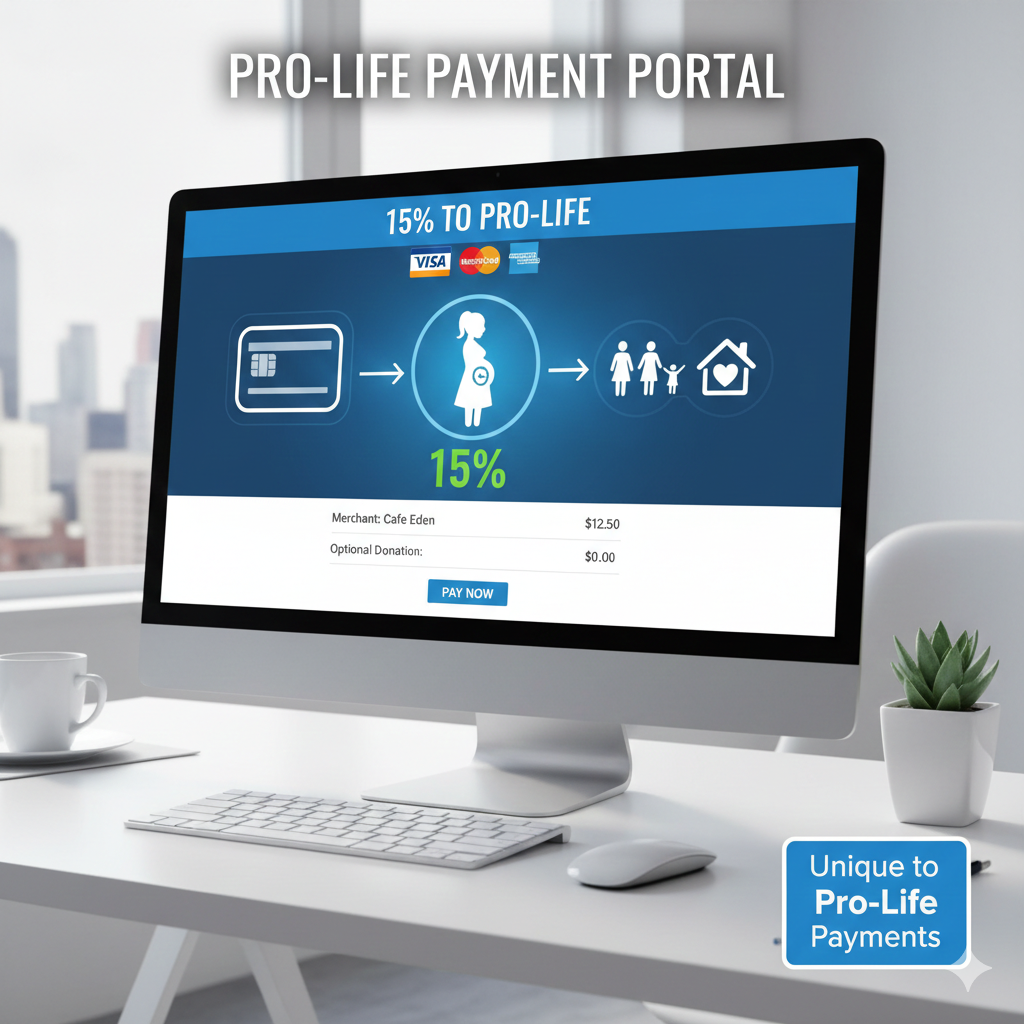
Explicit Pro-Life Mission: Pro-Life Payments donates 15% of gross revenue to pro-life organizations—not profit, but top-line revenue, which is fixed and verifiable.
-
Biblical Foundation: The company cites Exodus 23:19 and Jeremiah 1:5 as guiding scriptures and structures its giving model around the biblical concept of “first fruits.”
-
Values Screening: Pro-Life Payments refuses to work with businesses that promote abortion or undermine the sanctity of life, ensuring every transaction supports organizations aligned with pro-life values.
-
Pro-Life Prosper Donation Platform: Similar to GivingFuel, Pro-Life Payments offers Pro-Life Prosper, a comprehensive donor management and giving platform with customizable donation forms, analytics, recurring giving, text-to-give, ACH processing, and donor-paid fees.
-
Comprehensive Payment Services: Beyond donations, Pro-Life Payments offers e-commerce processing, omni-channel solutions, mobile card readers, retail and restaurant POS systems, and month-to-month contracts with no early termination fees.
-
Anti-Deplatforming Protection: Unlike secular processors that have banned patriotic, pro-life, and conservative businesses, Pro-Life Payments stands firmly behind its clients’ right to operate according to their convictions.
Must See Also: How to Maximize Donations with Pro-Life Friendly Payment Solutions
Who Owns Webconnex? The Founders Behind the Fundraising Platform
Webconnex was co-founded in 2008 by Eric Knopf and John Russell, two entrepreneurs based in Sacramento, California, who met at Westmont College, a Christian liberal arts institution in Santa Barbara. The company is 100% bootstrapped with no venture capital or outside funding, which means Knopf and Russell retain full ownership and control of the company’s direction.
Eric Knopf serves as Co-Founder and Co-CEO and lives in Incline Village (Lake Tahoe), Nevada. On his personal website, Knopf states: “Far beyond my love of startups and entrepreneurship is my devotion to my faith and love for Jesus. I founded a faith community called Epic Life where I have been preaching and teaching for 10 years.” He has also published a theology on the Will of God. On Instagram, Knopf describes himself as “All in for Jesus.” On the Praxis network site, Knopf is described as “passionate about developing the most generous and empowering company culture possible that exists to be a winsome apologetic for the Kingdom.” Knopf has also spoken at churches including Yountville Community Church and is connected to the Jesus Culture School of Leadership.
John Russell serves as Co-Founder and Co-CEO and lives in Newport Beach, California. Russell has served as a mentor/coach at the Biola Startup Competition, a faith-based business competition hosted by Biola University’s Crowell School of Business—a competition designed to help students “launch innovative, kingdom-minded businesses and nonprofits that have the potential to significantly impact the world for Christ.” Russell is described as “a life-long entrepreneur with expertise in marketing and sales strategy” who is part of the Praxis network.
Both founders are connected to Praxis, which describes itself as “a venture-building ecosystem awakening redemptive imagination” and “a Christian community” that requires all staff and program participants to affirm The Apostles’ Creed. Webconnex is listed as a Praxis Portfolio venture.
Must See Also: Aligning Your Business with Your Values: Pro-Life Payment Solutions
Christian Alternatives to Webconnex: Understanding the C-Suite Leadership
For organizations considering Christian alternatives to Webconnex, understanding who leads the company beyond the founders is important. The Webconnex executive team includes:
| Executive | Title | Source |
|---|---|---|
| Eric Knopf | Co-Founder / Co-CEO | |
| John Russell | Co-Founder / Co-CEO | |
| Ashley Mellott | Chief Operating Officer / Chief of Staff | |
| Sergio Scalise | Chief Financial Officer | LinkedIn / Webconnex |
| Nathanael Merrill | Chief Technology Officer | The Org |
| Justin Zoradi | Vice President of Marketing | |
| Shadi Hayek | Vice President of Sales | Growjo |
Ashley Mellott has been with Webconnex since 2009 and “played a central role in helping to scale Webconnex from a 4-person to a 104+-person team.” She initially served as “Director of Awesome First Impressions” before rising to COO/Chief of Staff in 2018.
Nathanael Merrill has served as CTO since April 2014, bringing a background that includes serving as Internet Director at the Luis Palau Association, a Christian evangelistic organization, from 2004 to 2006.
The company is headquartered in Sacramento, California at 120 K Street, with employees working remotely across the country. Webconnex has approximately 92–104 employees and reports a 97% employee retention rate. The company has processed over $4 billion for more than 60,000 customers.
Must See Also: Non-Christian Values of Major Payment Industry Providers
Christian Alternatives to Webconnex: The Bottom Line for Faith-Based Organizations
The evidence paints a nuanced but important picture. Webconnex’s co-founders, Eric Knopf and John Russell, are both professing Christians with deep faith commitments. Knopf preaches in churches, leads a faith community, and describes his company as “a winsome apologetic for the Kingdom.” Both founders are connected to the Praxis Christian venture network. The company was born at a Christian college and is entirely self-funded by its Christian founders.
However, Webconnex as a corporation has no public position on abortion, no stated stance on LGBTQ or transgender issues, no explicit rejection of DEI ideology, and no published commitment to pro-life causes. The company operates as a broad-market platform serving 60,000+ customers of all types, and its revenue model does not include any charitable commitment to life-affirming organizations.
For Christian organizations that want their processing fees and platform investments to actively advance pro-life work—rather than simply not opposing it—Pro-Life Payments offers the most explicitly aligned Christian alternative to Webconnex available today. Every transaction processed through Pro-Life Payments directly funds pregnancy resource centers, counseling services, and life-affirming ministries, turning routine financial operations into Kingdom impact.
The choice is clear for organizations that believe their business partnerships should reflect their mission: a Christian alternative to Webconnex exists, and it is saving babies with every swipe.
Must See Also: You Can’t Unsee It—And You Can’t Sleep Until You Act