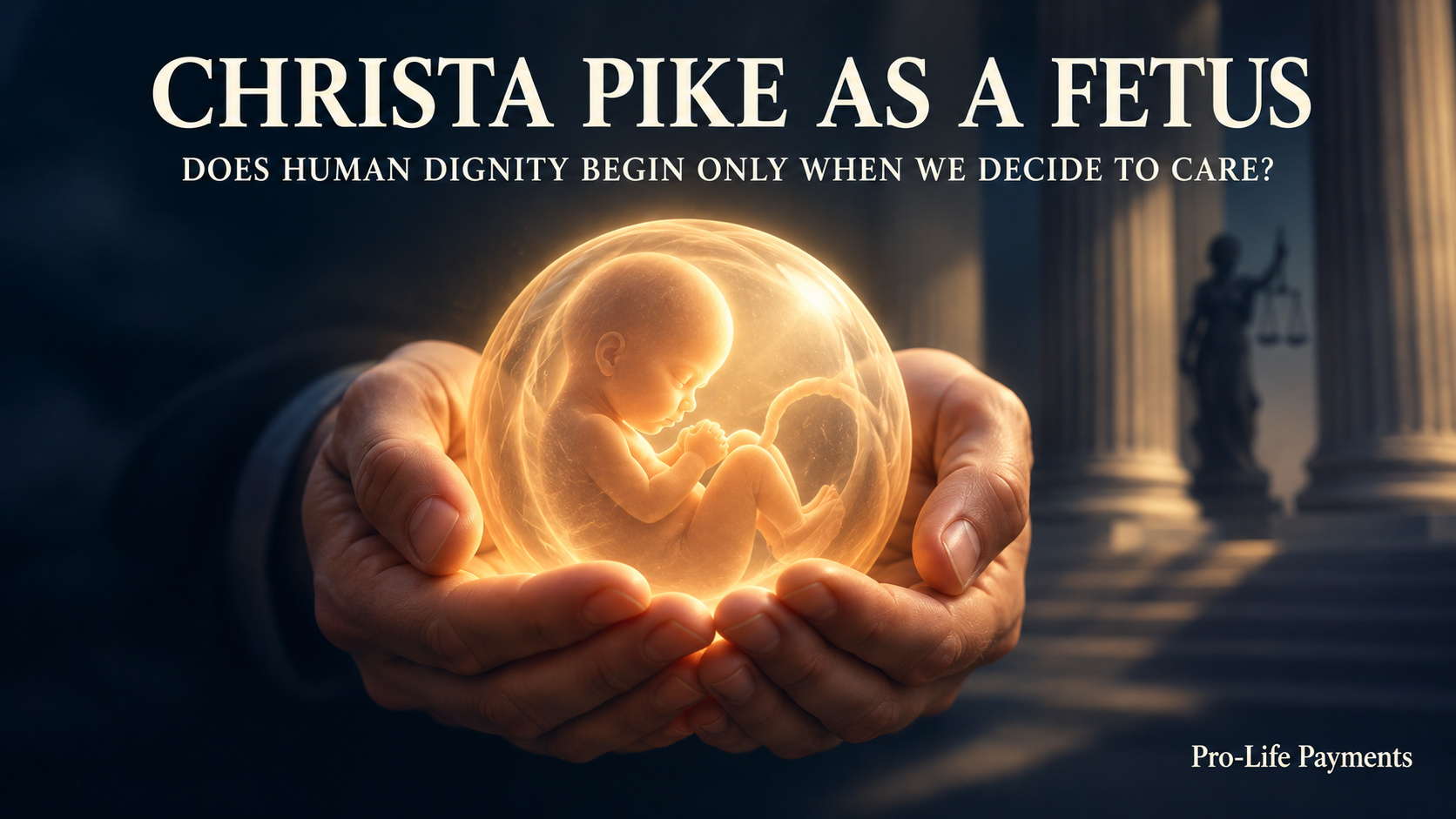
Does human dignity begin only when we decide to care about a vulnerable life?
The pro-life argument presented here is that human dignity is inherent, not granted by another person’s concern. Vulnerability should increase our responsibility to protect a human life rather than reduce its claim to protection. Christa Pike’s life before she committed a crime provides a thought experiment about that principle, while the argument also acknowledges bodily autonomy and duties toward pregnant women.
Imagine Christa Pike at an earlier stage of her existence: unborn, dependent, without a criminal history, and incapable of defending herself.
Would her vulnerability have strengthened the case for protecting her—or made it easier to disregard her?
That question reaches beyond one woman’s execution. It challenges the consistency of our moral convictions. When we insist that a convicted murderer must not be subjected to unnecessary suffering, we recognize that wrongdoing does not erase every claim to humane treatment. But if we recognize dignity after a terrible crime, what principle allows us to deny it before any crime has been committed?
This is a pro-life argument about the foundations of human worth. Its central claim is straightforward: Vulnerability should increase our responsibility to protect a human life, not reduce that life’s claim on our concern.
Christa Pike as a Fetus: The Same Life, Before the Headlines
Pike survived Tennessee’s September 30, 2026, execution attempt, and her attorneys subsequently reported that she was unconscious, critically ill, and receiving hospital treatment. Concern about her treatment did not require anyone to declare her innocent.
Neither should this discussion erase her victim. Pike was convicted of the 1995 murder of 19-year-old Colleen Slemmer. Slemmer’s life matters, and accountability for her murder matters.
But consider the earlier life invoked by this article’s title. Before Pike could choose good or evil, before she could help or hurt another person, she was developing in her mother’s womb.
This is a thought experiment—not a suggestion that her mother considered abortion.
The moral challenge is this: If we believe a person retains dignity despite her crimes, why would that dignity be absent before she was capable of committing them?
A pro-life answer does not make worth depend on a favorable biography. It begins with the conviction that human beings deserve protection because of what they are, not because someone approves of what they might become.
Christa Pike as a Fetus: Vulnerability Is Not a Moral Defect
The unborn child cannot argue a case, hire an attorney, organize supporters, or explain why her life matters.
For the pro-life position, those limitations are reasons for advocacy—not grounds for exclusion.
There is a profound difference between saying, “This individual cannot defend herself,” and concluding, “Therefore, we need not defend her.” The second statement turns powerlessness into permission.
We should ask ourselves:
Does dependence make someone less deserving of protection?
Does being unable to express a desire to live eliminate the importance of continued life?
Does another person’s rejection determine whether a human being has worth?
Should those with the least power receive the fewest protections?
These questions expose the principle at stake. If dignity is inherent, it cannot be something the powerful grant to the powerless only when doing so is convenient.
Philosophers describe “moral status” as the standing that makes an entity matter for its own sake and gives others reasons or obligations concerning its treatment. The pro-life contention is that unborn human life has that standing, rather than merely the value someone else chooses to assign it.
Must See Also:
Christa Pike as a Fetus: What Changes Between “Protect Her” and “End Her Life”?
The strongest challenge to abortion supporters is not an insult. It is a request for a defensible dividing line.
If an unborn child does not deserve protection, what precisely is missing—and why does that missing characteristic justify intentionally ending her life?
Abortion ethics debates offer several proposed thresholds, including consciousness, the capacity to feel pain, viability, and personhood. Those are substantive positions, not interchangeable slogans. Each requires its own defense.
For example, a threshold based on current abilities must explain why those abilities determine fundamental worth. A threshold based on viability must explain why the capacity to survive outside the womb carries decisive moral significance. A threshold based on being wanted must explain why another person’s preference should establish a right to live.
Not every abortion supporter relies on those arguments. But anyone who does should be willing to follow the chosen principle through its implications.
The pro-life objection is that development changes a human being’s abilities without necessarily changing whether that human being deserves protection. Growing stronger should not be the condition for becoming worthy of care.
Christa Pike as a Fetus: Addressing Bodily Autonomy Honestly
A serious article must confront the strongest opposing argument.
Pregnancy is not the same circumstance as imprisonment. The unborn child depends on a particular woman’s body, and pregnancy places demands on that woman. Some defenses of abortion therefore argue that even granting fetal personhood would not automatically establish a right to use the pregnant woman’s body.
That distinction matters. Concern for Pike after a failed execution does not, by itself, logically disprove every defense of abortion.
The pro-life response must make an additional moral argument: that pregnancy involves responsibilities toward a dependent child, and that bodily autonomy, while important, does not provide unlimited permission to intentionally end that child’s life. Pro-life philosopher Christopher Kaczor develops this parental-obligation response to the bodily-autonomy argument.
The disagreement is therefore not resolved by repeating “my body” or “innocent life.” It requires answering a difficult question: What obligations arise when protecting one human being’s life places serious demands on another?
A credible pro-life position should acknowledge those demands without concluding that the dependent child has no moral claim.
Christa Pike as a Fetus: Is “Murder” the Right Word?
From the pro-life moral perspective advanced here, intentionally killing an innocent unborn child is a grave injustice.
But precision strengthens that argument. Calling abortion “murder” expresses a moral judgment in this article; it should not be presented as a universal legal classification or as a conclusion accepted by everyone in the debate. The philosophical dispute includes both whether the fetus possesses a right to life and how that claimed right relates to the pregnant woman’s autonomy.
Those who support abortion should nevertheless face the underlying challenge without hiding behind terminology:
If abortion intentionally ends developing human life, why is that ending morally permissible? What makes the child’s claim to protection insufficient? And would the principle offered remain acceptable when applied consistently?
Using a less emotionally charged word does not answer those questions. Neither does using a more emotionally charged one.
The argument must stand on its reasoning.
Christa Pike as a Fetus: Moral Consistency Must Include the Mother
Consistency places obligations on pro-life advocates, too.
We cannot insist that dependence creates duties and then abandon pregnant women who need help. We cannot speak passionately about an unborn child’s vulnerability while treating her mother’s fear, hardship, or safety as irrelevant.
The position defended here demands concern for both.
That means a commitment to practical support: safe housing, appropriate medical care, protection from coercion and abuse, material assistance, and sustained help after birth. These are responsibilities the argument calls for—not proof that every organization already fulfills them.
Protecting unborn children should expand compassion, not narrow it.
Must See Also:

News Release: Planned Parenthood Whistleblower Leads Multi-National Women’s Healthcare Coalition
Christa Pike as a Fetus: The Question We Should Not Evade
Concern for Christa Pike is not evidence of hypocrisy by itself. People can oppose cruel punishment and support abortion through a moral framework they believe distinguishes the two. Challenging that framework requires examining its premises, not inventing motives.
But the challenge remains urgent.
If your concern rests on the belief that human dignity survives wrongdoing, explain why it does not precede wrongdoing.
If vulnerability calls forth your compassion in a hospital bed, explain why vulnerability in the womb receives a different response.
And if you believe unborn life may be intentionally ended, identify the morally relevant difference that permits it—and defend that difference consistently.
Before Christa Pike had a criminal record, she had a life. The pro-life conviction is that she did not need to become famous, independent, wanted, or capable of defending herself before that life deserved protection.
Her vulnerability was never the argument against protecting her. It was the reason protection mattered.