
For decades, Christian investors have understood pro-life investment funds as portfolios that screen out abortion-supporting companies and redirect capital toward life-affirming enterprises. But a revolutionary model has emerged: pro-life investment funds can be created not only through financial markets but also through everyday business activity, with services like Pro-Life Payments transforming transaction fees into a pooled fund that consistently advances the pro-life and faith-based movement.

Understanding Traditional Pro-Life Investment Funds
In 1994, Timothy Plan pioneered the first pro-life, pro-family screening standard, establishing a framework that would reshape how Christians think about investment responsibility. Traditional pro-life investment funds operate like any pooled investment vehicle: money from individual investors is combined into a single large fund, then deployed according to specific moral and financial criteria.
Faith-based investing uses three primary approaches: avoiding companies that violate biblical values (such as those involved in abortion, pornography, or gambling), engaging with corporations through shareholder advocacy to influence ethical practices, and impact investing that allocates capital to companies making a positive difference aligned with Christian principles. GuideStone Funds and Ave Maria Mutual Funds represent prominent examples of this traditional approach, screening portfolios to ensure investments align with the sanctity of life and other core Christian values.
The challenge many Christian investors face is that they may unknowingly fund the abortion industry through mutual funds and ETFs in their retirement accounts. Pro-life investors can be marching in Washington D.C. or supporting local pregnancy centers while simultaneously investing in companies that manufacture abortion drugs or provide abortion services, hoping for dividends and returns. This disconnect reveals why understanding where investment dollars flow matters profoundly for those committed to protecting life.
Must See Also: Pro-Life Payment Solutions: Why It Matters Where Your Processing Fees Go

How Pro-Life Investment Funds Work: The Pooled Capital Model
Traditional pro-life investment funds function through a straightforward pooled capital mechanism. Individual investors contribute money that is aggregated into one single account, creating economies of scale that open investment opportunities unavailable to smaller individual investors. When investors place capital in a pooled fund, they benefit from professional management, diversification across multiple holdings, reduced transaction costs per dollar invested, and the ability to participate in every investment the fund makes proportional to their contribution.
The fund’s professional managers use this pooled capital to purchase securities that meet both financial performance criteria and values-based screening standards. A trust indenture defines investor roles, management rights, distribution of earnings, fee structures, and other operational details, creating legal clarity about how the fund operates. Income earned from dividends and interest is typically distributed to fund owners, and when the fund sells securities at a profit, those gains are passed to investors as distributions.
For Christian investors, this structure means their capital is actively working according to pro-life principles, systematically excluding companies that profit from abortion while potentially investing in healthcare providers, adoption services, pregnancy resource centers, and other life-affirming enterprises. The pooled approach allows even modest investors to participate in a professionally managed, diversified portfolio that reflects biblical values without requiring them to research and vet individual stocks themselves.
Must See Also: The Future of Payment Processing for Pro-Life Businesses and Organizations
Beyond Wall Street: Pro-Life Investment Funds Through Business Operations
The pro-life investment fund concept extends far beyond traditional stock portfolios. Christian business owners move far more dollars through payment processing systems annually than through their brokerage accounts, yet few recognize that their payment processing fees represent one of the most immediate pro-life investing opportunities available. Every credit card transaction typically incurs fees of 2-4% plus a small per-transaction amount, and these fees flow to payment processors and their corporate partners.
When Christian businesses use mainstream processors, a portion of those fees may support Planned Parenthood, fund abortion travel expenses, or strengthen the financial infrastructure of the abortion industry. This creates a moral dilemma: businesses must accept credit cards to thrive, yet inadvertently contribute to causes that violate their deepest convictions. Many businesses are unaware that payment processing companies allocate portions of their revenue to pro-abortion advocacy groups, participate in fundraising for abortion access initiatives, or even cover costs for women to cross state lines for abortions.
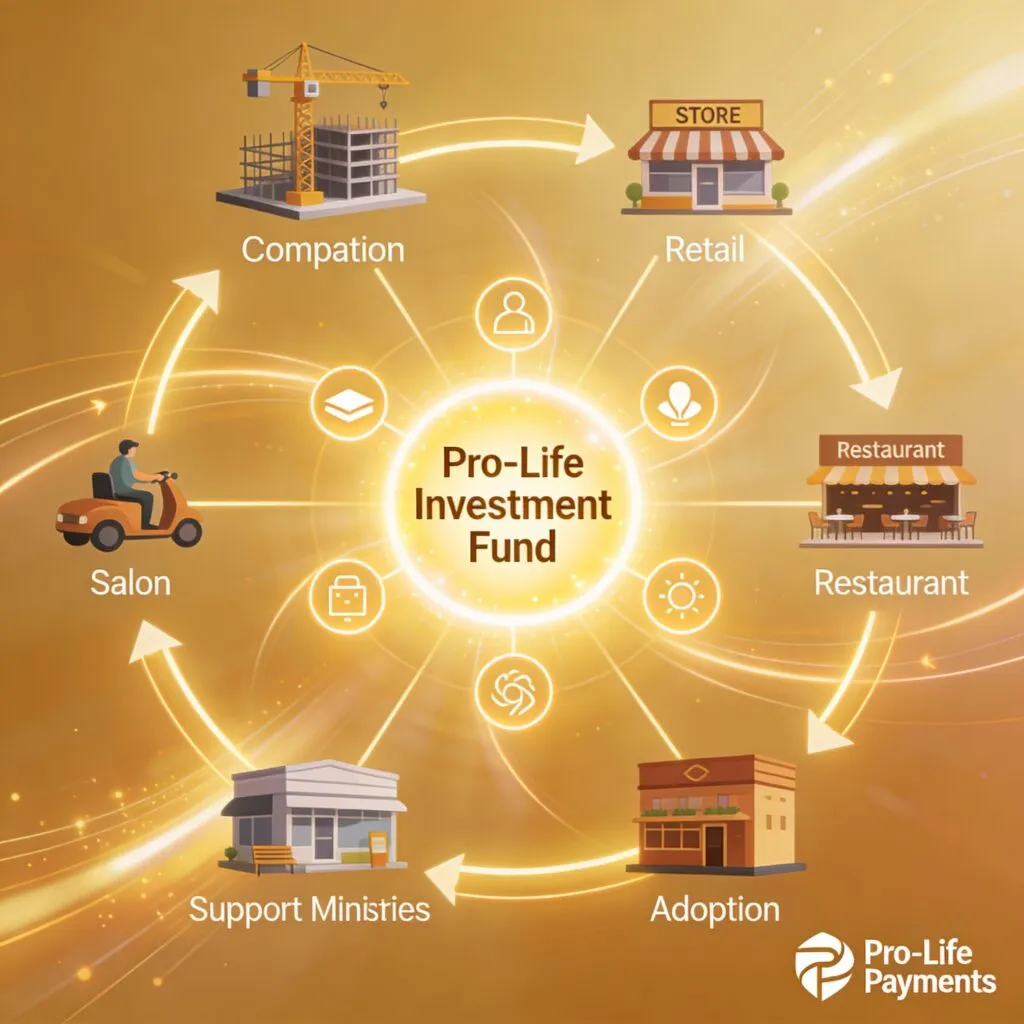
The solution lies in redirecting these fee streams through faith-aligned financial services that function as de-facto pro-life investment funds. When businesses switch to processors committed to life-affirming causes, the same transaction fees that previously funded abortion now flow into a pooled fund supporting pregnancy resource centers, life-affirming healthcare, and ministries serving mothers in crisis. This approach transforms operational expenses into ongoing pro-life investments, creating a sustainable funding model that compounds over time rather than requiring constant fundraising cycles.
Must See Also: Flexible Payment Processing for Pro-Life Organizations
Pro-Life Payments: A Real-World Pro-Life Investment Fund
Pro-Life Payments operates as a leading example of how transaction fees can function as a pro-life investment fund. Founded in 2021 and headquartered in Mt. Pleasant, South Carolina, Pro-Life Payments donates 15% of its gross revenue—not net profit, but total revenue—to pro-life organizations that protect unborn children and support mothers in need. This “first fruits” model, inspired by Exodus 23:19, ensures that every transaction processed contributes to a shared pool of capital systematically deployed for life-affirming work.
The mechanics mirror traditional investment funds: individual “investors” (in this case, Christian businesses and ministries) contribute to a pooled fund (by processing transactions through Pro-Life Payments), and that collective capital is professionally managed and distributed according to specific mission criteria (the 15% donation to vetted pro-life organizations). Because this 15% comes from transaction fees collected across a growing network of faith-based businesses, every sale, invoice, and donation processed effectively flows into a continuously replenished pro-life investment fund.
Pro-Life Payments serves Catholics, Evangelicals, Jews, Muslims, and all who support life, offering comprehensive payment solutions including e-commerce processing, retail and restaurant point-of-sale systems, mobile card readers, ACH payments, and donation management tools for churches and nonprofits. The platform provides competitive rates, free equipment and POS rentals, month-to-month contracts with no early termination fees, and next-day or same-day funding, ensuring businesses receive professional-grade services while their transaction fees fund the pro-life movement. On average, every $600 donated to organizations like Pre-Born helps persuade one abortion-determined woman to choose life.
Must See Also: Discover the Baby Saving Calculator
How Transaction Fees Create Compounding Pro-Life Investment Funds
Traditional pro-life investment funds require conscious decisions to allocate surplus capital, but transaction-based pro-life investment funds operate automatically with every business operation. When ministries and businesses switch to Pro-Life Payments, they redirect fees away from abortion-supporting processors and toward a structured contribution mechanism where a predictable percentage of gross processing revenue is systematically allocated to life-affirming ministries.
This creates what financial analysts would recognize as compounding returns: last year’s participating businesses continue generating donations through their ongoing transactions, this year’s new partners layer additional volume on top, and the cumulative effect grows exponentially as more Christian businesses join the network. Unlike annual fundraising campaigns that reset to zero each January, this transaction-driven model builds a durable foundation where every new business adds to a shared, expanding stream of funds supporting pregnancy centers, outreach, and life-affirming care.
The concept of “stealth philanthropy” captures this dynamic perfectly: customers purchasing from Christian businesses unknowingly contribute to life-saving work with every transaction, while business owners fulfill their calling to advance the Kingdom through their commercial operations. By 2030 projections, if over 50,000 businesses adopt this model, annual donations to pro-life causes could surge from $1.2 billion (2024) to $4.8 billion, funding an expansion of services that could prevent 500,000 abortions annually—with pregnancy centers attributing 80% of saved lives to these expanded resources.
Must See Also: A FinTech That Supports the Long-Term Health of Women Through Pro-Life Advocacy
The Collective Power of Pro-Life Investment Funds in Action
The network effect distinguishes transaction-based pro-life investment funds from traditional charitable giving. When a single business switches to Pro-Life Payments, it “locks in” that business as a long-term, structural partner whose support is embedded in daily operations rather than dependent on annual appeals or donor cultivation events. As more businesses join, they collectively create a self-sustaining ecosystem where money flows in the right direction—away from Planned Parenthood and toward pregnancy resource centers, adoption agencies, maternity homes, and support services for mothers in crisis.
This pooled approach mirrors how traditional investment funds benefit from economies of scale: larger aggregate capital allows for more strategic deployment, broader impact, and reduced overhead costs per dollar invested. Pro-Life Payments’ partnership model distributes a portion of donations from merchants unaffiliated with specific ministries among all participating ministries in the referral network, ensuring that every organization benefits as the entire ecosystem grows, not just from their direct referrals.
The influx of capital from this collective fund enables pro-life organizations to scale initiatives that would be impossible through fragmented individual donations: thousands of new pregnancy resource centers providing free ultrasounds and prenatal care, 24/7 crisis hotlines connecting women to immediate support, housing and job training programs addressing root causes of abortion decisions, multimedia campaigns reaching over 100 million viewers annually, and state-funded alternatives-to-abortion programs offering comprehensive support. Cultural transformation follows: polls show significant increases in pro-life sentiment when communities witness expanded support for mothers and babies, driven by heightened awareness that choosing life is easier, kinder, and more supported than ever before.
Must See Also: Baby Saving Calculator for Christian Businesses
Measuring Impact: How Pro-Life Investment Funds Save Lives
A defining feature of serious investment funds is measurability—investors need verifiable data about returns on capital. Traditional pro-life investment funds report financial performance alongside values alignment, while transaction-based pro-life investment funds measure impact in lives saved. The Baby Saving Calculator translates processing volume into tangible outcomes, helping Christian businesses visualize how their participation in a pro-life fee stream equates to babies saved, mothers helped, and ministries strengthened.
The calculation is straightforward: on average, every $500 donated to organizations like Pre-Born helps persuade one abortion-determined woman to choose life. When a business processes $100,000 annually through Pro-Life Payments at typical processing rates, the resulting 15% donation from Pro-Life Payments’ revenue on that volume provides measurable support for pregnancy resource centers offering ultrasounds, prenatal care, counseling, and material aid. This transparency allows business owners to see exactly how their payment processing volume translates into real help for babies and mothers, whether they run a construction company, retail store, restaurant, salon, or any other business.
Unlike speculative financial investments where returns fluctuate with market conditions, the ROI from demand-side pro-life investments is practically guaranteed and achieved quickly—sometimes within days following the investment. This predictability provides both emotional satisfaction and logical justification for Christian business owners who want to see immediate, verifiable impact from their pro-life commitment. Over time, the cumulative effect of hundreds or thousands of businesses channeling transaction fees into this collective fund creates a scalable funding engine that amplifies every baby-saving effort, turning the mundane act of commerce into a daily investment in life.
Must See Also: Christian Merchant Services: Pro-Life Payments Company Profile
Why Christian Investors Should Support Pro-Life Investment Funds Beyond the Stock Market
For Christian investors committed to pro-life principles, the question is not whether faith-aligned investment opportunities exist, but whether believers will harness them deliberately. Morgan Stanley’s framework for Christian investors acknowledges that stewardship includes examining how faith informs investment decisions across all pools of capital—financial, philanthropic, and operational. Nearly 2.5 billion people worldwide identify as Christian, and many seek to embrace their faith holistically, leading religious values to play a critical role in how they allocate resources.
The operational spending of Christian businesses represents a massive, largely untapped opportunity for pro-life investment. Payment processing alone channels billions of dollars annually through financial systems, and when those fees flow through abortion-supporting processors, Christian businesses inadvertently subsidize the industry they oppose. Switching to Pro-Life Payments allows believers to transform routine operational expenses into strategic pro-life investments that require no additional budget, no extra fundraising, and no sacrifice of service quality or competitive rates.
The biblical principle of stewardship demands that Christians manage resources entrusted to them in ways that honor God and advance His Kingdom. As written in 1 Corinthians 4:2, “it is required of stewards that one be found trustworthy.” When Christian business owners align their payment processing with their values, they exercise faithful stewardship over both their financial operations and their moral witness. This approach creates a continuous flow where every transaction pours into a long-term river of support for mothers and babies, enabling ministries to plan more confidently, expand services, and invest in deeper discipleship and aftercare with a growing, transaction-based foundation underneath traditional annual appeals.
Must See Also: Pro-Life Payments Donates 15% of its Gross Revenues to Your Pro-Life Ministry
Taking Action: Joining the Pro-Life Investment Fund Movement
Christian investors ready to participate in pro-life investment funds have clear pathways forward. For traditional securities portfolios, investors can request complimentary portfolio screening from advisors specializing in biblically responsible investing to discover whether current holdings support abortion or other harmful industries, then reallocate capital to funds like Timothy Plan, Ave Maria, GuideStone, or Inspire that systematically exclude life-violating companies while pursuing competitive financial returns.
For business operations, the transition to Pro-Life Payments is straightforward: organizations apply online, receive personalized onboarding support, and quickly begin processing payments in a way that aligns operations with faith while funding pro-life ministries with every transaction. The platform offers comprehensive solutions including e-commerce, omni-channel payments, point-of-sale systems, mobile readers, ACH processing, and donation management for churches and nonprofits—all with competitive pricing, next-day funding, free equipment, and month-to-month contracts with no termination fees.
Christian entrepreneurs and ministry leaders can visit the Baby Saving Calculator to estimate how many lives their business could help save annually through redirected transaction fees, then contact Pro-Life Payments to begin transforming routine payment processing into a direct funding stream for the pro-life movement. As more believers recognize that pro-life investment funds can be created not only through financial markets but through everyday business activity, the collective impact builds a financial ecosystem where choosing life becomes structurally easier and more supported—proving that for believers committed to stewardship and the sanctity of life, every transaction truly can be an act of worship and an investment in the Kingdom.
Must See Also: The Ultimate Guide to Christian Merchant Services