
Why Finding the Best Christian and Pro-Life Attorneys Starts with Actions, Not Advertisements
The best Christian and pro-life attorneys are not necessarily those who display the most prominent religious symbols in their office or advertise their faith most loudly. Rather, they are attorneys whose daily practices, business relationships, and financial decisions demonstrably align with the pro-life values they profess. For Christian business owners seeking legal representation, this distinction matters tremendously. An attorney may claim pro-life convictions while simultaneously funding abortion-supporting vendors, using payment processors that donate to Planned Parenthood, or maintaining business relationships that directly contradict the sanctity of life. This article provides a comprehensive framework for identifying attorneys whose behaviors match their stated beliefs—and explains why pro-life business owners should apply this same vendor-vetting rigor across all their professional relationships.
Must See Also: Speak-up for what you believe in and align your business practices with your morals and values
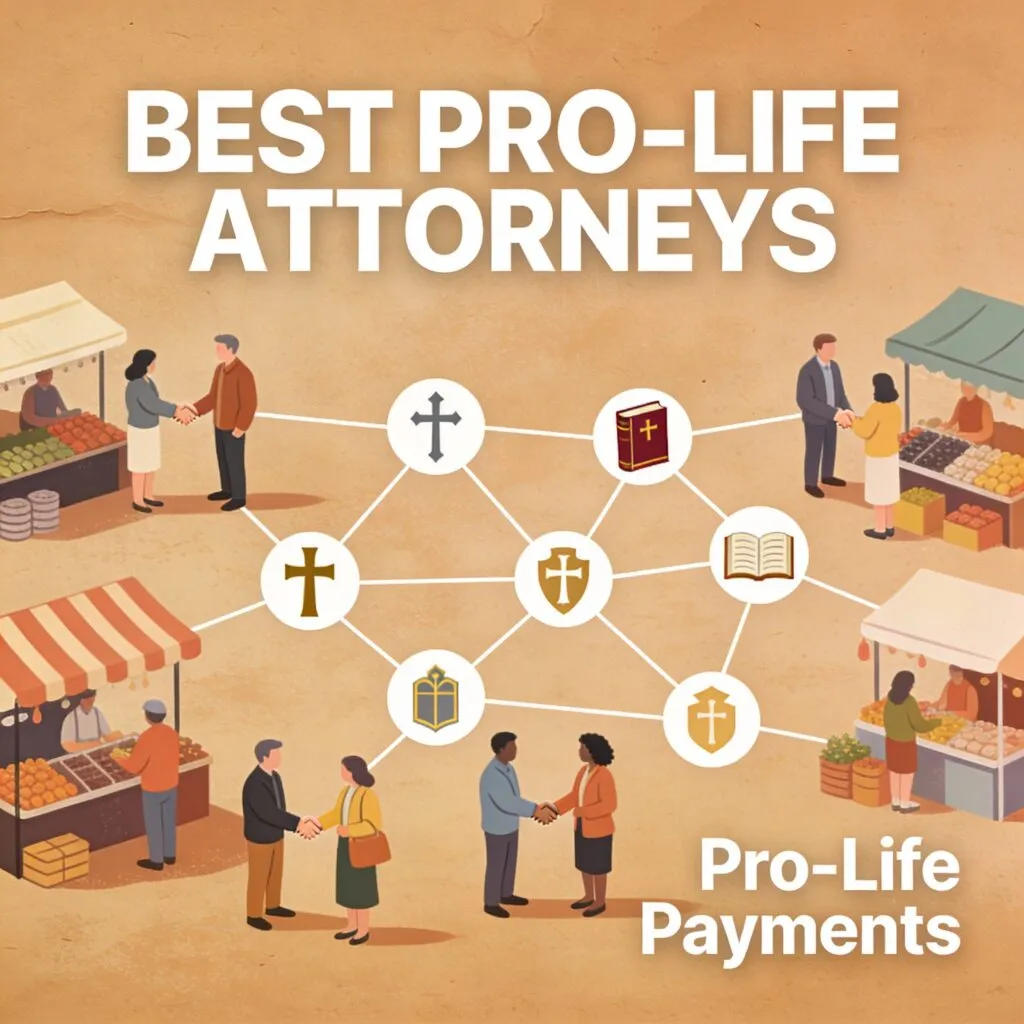
Understanding What Makes the Best Christian and Pro-Life Attorneys
The Christian Legal Society maintains a directory of attorneys who have signed their Statement of Faith, providing a starting point for finding legal counsel. Similarly, organizations like NIFLA (National Institute of Family and Life Advocates) have spent over 25 years protecting pro-life pregnancy centers through legal counsel and advocacy. These directories offer valuable resources, yet membership alone does not guarantee that an attorney’s entire business ecosystem reflects pro-life values.
The most effective Christian and pro-life attorneys demonstrate their commitment through tangible choices. They select vendors, payment processors, and service providers that align with their stated beliefs. They avoid partnerships with companies that fund abortion advocacy. They construct their professional infrastructure intentionally, recognizing that every dollar spent on operating expenses represents a values statement. When evaluating an attorney’s values alignment, Christian business owners should look beyond religious affiliation to examine the attorney’s operational decisions.
Must See Also: Core Christian Values: The Role of Pro-Life Payments in Promoting and Supporting Christian Families

How to Vet the Best Christian and Pro-Life Attorneys Through Their Business Practices
Vetting attorneys requires examining their entire business ecosystem, not merely their case history or theological statements. Christian business owners should investigate which payment processor an attorney uses for client transactions. Many mainstream processors, including PayPal and its subsidiary Venmo, are signatories to principles that support removing legal barriers to abortion. Similarly, platforms like Stripe fund climate change initiatives and other progressive causes that may conflict with Christian worldviews.
Ask prospective attorneys directly about their vendor selection criteria. Do they prioritize faith-aligned suppliers? Have they audited their technology stack to ensure their software vendors, office supply companies, and professional service providers share pro-life convictions? The Christian small business accountant framework emphasizes that accountants now routinely provide guidance on vendor selection decisions, positioning them as gatekeepers for values-aligned business relationships. The same principle applies to attorneys—their vendor choices reveal their true priorities.

Examine whether the attorney’s law firm has established partnerships with pro-life organizations. Do they provide pro-bono services to pregnancy resource centers? Have they defended faith-based organizations in legal disputes? Organizations like the Thomas More Society have established themselves as leading pro-life law firms through decades of litigation defending the unborn. The best Christian and pro-life attorneys follow this model, using their legal expertise to advance life-affirming causes beyond mere compliance with bar association ethics requirements.
Must See Also: Christian Small Business Accountants
Practice Areas Where the Best Christian and Pro-Life Attorneys Excel
The best Christian and pro-life attorneys work across numerous practice areas, each offering unique opportunities to advance Kingdom values. Faith-based law firms specializing in church and nonprofit law help religious organizations navigate tax-exempt status, governance issues, and property disputes while maintaining their Christian witness. These attorneys understand that legal disputes can detract from a church’s primary mission and work to resolve conflicts through mediation and arbitration when possible.
Family law represents another critical area where Christian attorneys make substantial impact. Attorneys practicing adoption law, parental rights advocacy, and marriage counseling help families navigate complex legal frameworks while upholding biblical principles regarding marriage and family structure. The best Christian and pro-life attorneys in this space go beyond legal compliance to provide holistic support that reflects a comprehensive pro-life worldview—one that values life from conception through natural death.
Constitutional law and religious liberty cases increasingly require attorneys who combine legal excellence with unwavering commitment to Christian principles. Organizations like Advocates for Faith & Freedom and Americans United for Life demonstrate how attorneys can defend religious liberty while advocating for life-affirming legislation. These attorneys recognize that legal advocacy extends beyond courtroom victories to include legislative reform, public policy development, and cultural engagement.
Business and commercial law provides Christian attorneys opportunities to help faith-based entrepreneurs build Kingdom-advancing enterprises. Attorneys who understand Christian business ethics and vendor selection can guide clients toward building entire supply chains composed of faith-aligned partners, transforming ordinary business expenses into investments in the Christian business ecosystem.
Must See Also: 10 Pro-Life Business Investment Ideas That Support Life and Strengthen Your Returns
Why Pro-Life Business Owners Should Choose the Best Christian and Pro-Life Attorneys and Vendors
Christian business owners bear stewardship responsibility for every financial decision, including vendor selection. The biblical principle of bringing “the choice first fruits of your soil into the house of the Lord” (Exodus 23:19) extends beyond tithing to encompass all business relationships. When a business owner pays $50,000 annually to a secular law firm with no visibility into how those profits ultimately get used, they forfeit any accountability for whether their legal fees fund causes contradicting Christian values.
Constructing deliberate vendor networks composed of faith-aligned businesses transforms supply chain expenses into pro-life business investments. Most businesses spend 40-60% of revenue on cost of goods sold, operating expenses, and vendor services—creating substantial opportunities to redirect cash flows toward Christian-operated suppliers. The cumulative impact proves substantial: A business spending $500,000 annually on vendors who redirects 50% of those expenditures to faith-aligned suppliers effectively invests $250,000 into the Christian business ecosystem, strengthening employment, entrepreneurship, and charitable giving throughout the faith community.
The network effects multiply as Christian businesses preferentially transact with one another. Faith-aligned vendor networks provide values certainty that secular vendors cannot match. Christian businesses prioritize ethical behavior, transparency, and integrity, with accountability built into operating principles. Market discipline within the Christian business community rewards excellence while marginalizing poor performers, creating quality standards that benefit all participants.
Must See Also: Pro-Life Christian Investing: How to Let Your Portfolio Speak Up for the Unborn
The Pro-Life Payments Model: Turning Everyday Transactions Into Recurring Pro-Life Funding
One of the most powerful investments a Christian business can make is switching to Pro-Life Payments, because it transforms every future transaction into a reliable stream of funding for pro-life and faith-based work. Unlike occasional symbolic gifts that depend on remembering to donate or having surplus cash available, switching payment processors creates an automated, recurring revenue stream for the pro-life movement that operates with every customer transaction.
Pro-Life Payments donates 15% of gross revenue—not profits, but total revenue—to pro-life organizations that provide support, education, and resources to pregnant women. This means every credit card swipe, every online purchase, every donation processed through the platform automatically generates funding for pregnancy resource centers, maternity homes, and life-affirming organizations. The business owner makes no additional effort beyond the initial decision to switch processors, yet the impact compounds with every transaction.
Consider the long-term mathematics. Recurring donors have the highest lifetime financial return, 42% above fundraisers and 440% above one-time donors. A business processing $500,000 annually in transactions through Pro-Life Payments generates $75,000 in pro-life funding each year without any additional conscious decision or effort. Over a decade, that single vendor switch produces $750,000 in mission-aligned funding—far exceeding what most businesses donate through occasional special gifts or annual fundraising campaigns.
The comparison to other popular payment processors proves stark. Mainstream processors like PayPal, Stripe, and Square offer no mission-aligned giving whatsoever. Worse, many actively fund causes directly opposed to Christian values, including abortion access, LGBTQ advocacy, and progressive political campaigns. Every transaction processed through these platforms directs profits toward ideological opponents of the pro-life movement. In contrast, Pro-Life Payments provides competitive rates and hardware similar to mainstream processors while ensuring transaction fees support life-affirming causes.
Must See Also: A Viable Faith-Based Alternative to Stripe
Comparing Recurring Mission-Aligned Spending to Occasional Symbolic Gifts
The power of recurring, mission-aligned spending dramatically outperforms occasional donations in long-term impact. Recurring donation revenue increased 144% from 2018 to 2022 across nonprofits of all sizes, demonstrating the sustainability and growth potential of predictable giving streams. While the average recurring donor gave $941 annually compared to $2,155 from non-recurring donors, the lifetime value calculation reverses dramatically when donor longevity is factored in. Recurring donors provide nearly double the lifetime value of one-time donors because they maintain relationships with organizations for years rather than making single gifts.
Mission-aligned vendor selection creates the same dynamic at business scale. A one-time $10,000 donation to a pregnancy resource center provides immediate impact but requires conscious decision-making, budget availability, and ongoing commitment to repeat. In contrast, switching to Pro-Life Payments for a business processing $500,000 annually generates $75,000 in pro-life funding the first year, $75,000 the second year, and $75,000 every subsequent year without any additional decisions. The funding scales automatically as the business grows—if transaction volume increases to $750,000, pro-life funding rises to $112,500 without any conscious effort beyond the initial vendor switch.
The psychological and operational benefits prove equally valuable. Recurring donors create predictable revenue streams that allow nonprofits to plan strategically, hire staff, launch programs, and invest in growth initiatives. Mission-aligned vendors provide the same benefit at scale. Pregnancy resource centers receiving consistent monthly funding from Pro-Life Payments can budget confidently, knowing that transaction volume from hundreds of Christian businesses provides stable baseline revenue independent of traditional fundraising campaigns.
Monthly giving programs prove more cost-effective than fundraisers and one-time donor acquisition, keeping overhead low while maximizing return on investment. The same principle applies to mission-aligned vendor selection—once a business switches to Pro-Life Payments, it generates pro-life funding indefinitely without ongoing acquisition costs, campaign planning, or donor cultivation efforts. The vendor relationship itself becomes the giving mechanism.
Must See Also: How to Maximize Donations with Pro-Life Friendly Payment Solutions
Practical Steps to Find and Work With the Best Christian and Pro-Life Attorneys
Begin the search for Christian legal counsel by consulting established directories like the Christian Legal Society’s attorney referral service, which lists current regular members who have signed the CLS Statement of Faith. Organizations like Focus on the Family provide referrals to attorneys associated with Christian Legal Society, offering a starting point for the vetting process.
Once you identify potential attorneys, conduct thorough values-alignment research. Request information about their vendor selection policies. Ask whether they use faith-aligned payment processors, accounting firms, and professional service providers. Inquire about their pro-bono work with faith-based organizations and pregnancy resource centers. The best Christian and pro-life attorneys readily provide this information because they view vendor selection as an extension of their ministry rather than merely a business decision.
Evaluate the attorney’s practice areas and client base. Do they primarily represent clients whose values align with Christian principles? Have they defended religious liberty cases or represented pro-life organizations? Attorneys who merely tolerate Christian clients differ substantially from those who intentionally build practices serving the faith community. Law firms that clearly define and communicate their core values create environments where values-aligned work thrives.
Consider the attorney’s approach to conflict resolution. Christian attorneys who prioritize mediation, arbitration, and collaborative problem-solving over aggressive litigation often demonstrate more holistic commitment to biblical principles. While litigation sometimes proves necessary, attorneys who exhaust reconciliation opportunities first typically reflect deeper understanding of Christian teaching regarding dispute resolution.
Must See Also: Christian Merchants’ Values-Based Business Metrics
Building a Complete Ecosystem of Pro-Life Professional Service Providers
The same vetting process used for attorneys should extend across all professional service relationships. Christian business owners should audit their entire vendor network, identifying opportunities to transition toward faith-aligned alternatives. Professional services including accounting, legal, marketing, consulting, and IT services represent particularly strategic categories for faith-aligned sourcing because these relationships involve significant annual expenditures and ongoing collaboration.
Financial services offer immediate opportunities for values alignment. Banking, payment processing, insurance, and benefits administration collectively represent substantial business expenses that can redirect toward Christian-operated providers. Pro-Life Payments exemplifies this approach, offering comprehensive payment solutions including e-commerce, omni-channel, mobile, retail, restaurant, and giving/tithing platforms specifically designed for faith-based communities. The company provides competitive rates, next-day or same-day deposits, month-to-month contracts with no termination fees, and free equipment rentals—matching or exceeding mainstream processor offerings while ensuring transaction fees fund pro-life causes.
Technology and software vendors similarly merit values-based evaluation. Many Christian businesses unknowingly support companies whose leadership actively opposes Christian values through their choice of productivity software, donor management platforms, and communication tools. Identifying faith-aligned alternatives across the technology stack ensures that software subscription fees support Kingdom-advancing enterprises rather than ideological opponents.
The marketplace increasingly offers faith-aligned options across virtually every business category. Platforms like Galilee Life operate as Christian marketplaces specifically designed to connect faith-based vendors with consumers and businesses, featuring handcrafted products, Christian literature, apparel, and home goods from vendors who integrate faith into their business operations. As more Christian entrepreneurs build alternatives to secular vendors, the faith-based business ecosystem strengthens, creating network effects that benefit all participants.
Must See Also: Baby Saving Calculator for Christian Businesses
The Long-Term Impact of Mission-Aligned Business Decisions
Christian business owners who intentionally construct faith-aligned vendor networks create cascading economic benefits throughout the Christian community. As Christian businesses preferentially transact with one another, they collectively build a parallel economy supporting faith-based employment, entrepreneurship, and charitable giving. A Christian restaurant sourcing from Christian food distributors, using Christian payment processors, and partnering with Christian marketing agencies creates ripple effects that strengthen the entire faith-based business ecosystem.
The cumulative financial impact proves substantial. A business spending $500,000 annually on vendors who redirects even 50% of those expenditures to faith-aligned suppliers effectively invests $250,000 into the Christian business ecosystem each year. Over a decade, that represents $2.5 million in economic activity directed toward businesses that share pro-life, pro-family convictions. The multiplier effects extend beyond direct expenditures as Christian vendors hire Christian employees, donate to faith-based charities, and themselves prioritize faith-aligned suppliers.
Consumer marketing benefits emerge naturally from faith-aligned vendor networks. Businesses can authentically communicate their values commitment to customers: “We source 80% of our products from Christian-owned suppliers committed to pro-life values” becomes a compelling brand differentiator for the significant consumer segment receptive to Christian business principles. Research shows that consumers increasingly make buying decisions based on companies’ stances on social issues including abortion, making vendor network transparency a competitive advantage.
The strategic value extends to organizational resilience. Faith-aligned vendor relationships typically prove more stable and collaborative than purely transactional secular partnerships. Christian businesses prioritize transparency, integrity, and fairness, creating trust-based relationships that weather economic uncertainty more effectively than relationships based solely on price competition.
Why the Best Christian and Pro-Life Attorneys Understand Stewardship Accountability
The best Christian and pro-life attorneys recognize that their professional practice represents stewardship responsibility extending beyond individual client representation to encompass their entire business ecosystem. They understand that vendor selection decisions carry moral weight equivalent to case selection decisions. An attorney who refuses to represent abortion clinics while simultaneously using payment processors that fund Planned Parenthood demonstrates incomplete values alignment.
Stewardship accountability means accepting responsibility for the ultimate use of every dollar spent in business operations. When attorneys pay monthly software subscription fees, those payments become revenue for the software company, which uses that revenue for salaries, expansion, charitable giving, and political advocacy. If the software company’s leadership opposes Christian values, the attorney’s subscription fees indirectly fund causes contradicting their stated beliefs. The best Christian and pro-life attorneys audit these relationships systematically, identifying opportunities to redirect expenditures toward vendors whose values align with biblical principles.
This stewardship framework applies equally to Christian business owners selecting attorneys and other professional service providers. Business owners bear responsibility for ensuring their vendor expenditures support rather than undermine their faith convictions. The cumulative impact of these decisions shapes the broader culture—when Christians collectively direct trillions of dollars in annual spending toward secular vendors with hostile values, they subsidize the opposition while starving faith-aligned alternatives of the capital needed for growth and sustainability.
The Pro-Life Payments model demonstrates how individual vendor decisions aggregate into movement-level impact. Each business that switches to Pro-Life Payments contributes its transaction volume to a growing funding stream for pregnancy resource centers, maternity homes, and life-affirming organizations. As more businesses switch, the funding stream grows proportionally, creating compounding returns that far exceed what individual businesses could achieve through sporadic donations.
Must See Also: Christian Alternative to Classy Payment Processing
Taking Action: Practical Steps Toward Values-Aligned Business Operations
Christian business owners ready to align their operations with pro-life values should begin with systematic vendor audits. Create comprehensive lists of all current vendors across categories including professional services (attorneys, accountants, consultants), financial services (banks, payment processors, insurance), technology (software, hardware, telecommunications), and supplies (office, inventory, facilities). For each vendor, research the company’s leadership, charitable giving, political advocacy, and public statements regarding social issues.
Prioritize the highest-impact transitions first. Payment processing represents an ideal starting point because the switch delivers immediate mission-aligned impact while maintaining full functionality. Pro-Life Payments offers support for various payment types including e-commerce, omni-channel, mobile, retail, restaurants, and giving/tithing, ensuring businesses can transition seamlessly regardless of their business model. The platform provides free equipment and POS rentals, next-day or same-day deposits, month-to-month contracts with no early termination fees, and buyouts for existing contracts—eliminating common barriers to switching processors.
Use the Baby Saving Calculator to quantify the pro-life impact of switching payment processors. In just 30 seconds, businesses can discover how their transaction volume translates into funding for life-affirming organizations. This tangible accountability metric transforms abstract values alignment into concrete impact measurement, demonstrating exactly how many lives a business’s payment processing choice could help save.
Expand the audit systematically across other vendor categories. When current contracts expire, evaluate faith-aligned alternatives before defaulting to renewal. Inform existing vendors of your values-alignment priorities, offering opportunities for vendors to document their own pro-life commitments or providing referrals to faith-aligned alternatives. Many vendors may share Christian values without prominently advertising them—opening conversations can reveal alignment that wasn’t immediately apparent.
Document and communicate your values-aligned vendor network to stakeholders. Customers, employees, and ministry partners often deeply appreciate businesses that operationalize their faith through vendor selection. Consumer research shows significant market segments prioritize values-aligned purchasing, making vendor network transparency a genuine competitive advantage rather than merely an ethical obligation.
The pro-life movement needs more than weekend volunteers and annual donations. It needs entrepreneurs who recognize that their businesses—their vendor relationships, payment processors, legal counsel, and operational decisions—represent some of the most powerful pro-life tools available. When Christian business owners harness these tools deliberately, they create sustainable funding streams that support pregnancy resource centers, life-affirming organizations, and Kingdom-advancing enterprises for generations to come.