Executive Summary
This comprehensive research report examines Finix, a prominent payment processing infrastructure platform, through the lens of Christian and pro-life values. Our investigation reveals that Finix, founded in 2015 by Richie Serna and Sean Donovan, has positioned itself as a technology-first company focused on democratizing payment processing for businesses of all sizes. However, the company maintains a conspicuous silence on critical social issues that matter to faith-based communities. Unlike competitors who have publicly declared support for abortion access, LGBTQ+ advocacy, and diversity-equity-inclusion (DEI) initiatives, Finix has avoided making public statements on these matters. This neutrality, while potentially strategic from a business perspective, leaves Christian organizations questioning whether their payment processing partner aligns with their core values. The report concludes that Finix’s lack of transparency on these issues, combined with its Silicon Valley heritage and progressive-leaning investor base, suggests the company likely does not share Christian, pro-life values, making the search for Christian alternatives to Finix a necessary endeavor for faith-based organizations.
Must See Also: Wombs of Death: Abortion and the Illusion of Liberal Compassion
Finix Company Overview and Mission
Finix operates as a full-stack payment processor that enables software companies, marketplaces, and e-commerce businesses to own, manage, and monetize their payment infrastructure. The company’s mission centers on creating the most accessible financial services ecosystem in history by providing universal APIs and intuitive dashboards that allow businesses to embed payments quickly and scale revenue. Headquartered in San Francisco with additional operations in Cincinnati, Finix processes billions of dollars annually for over 12,000 merchants including Lunchbox, AgVend, Clubessential, Passport, Vroom, and Meadow. The company has raised over $135 million in venture capital funding from prominent investors including Bain Capital Ventures, Acrew Capital, Lightspeed Venture Partners, Visa, American Express, and Insight Partners. This substantial backing from traditional financial institutions and Silicon Valley venture firms suggests a corporate culture aligned with mainstream tech industry values rather than explicitly Christian principles.
Must See Also: Core Christian Values: The Role of Pro-Life Payments in Promoting and Supporting Christian Family Values
Leadership and Ownership Structure
Finix’s leadership team reflects typical Silicon Valley demographics and career trajectories rather than faith-based business leadership. CEO and Co-Founder Richie Serna, a Harvard graduate and former engineer at Balanced Payments, leads the company alongside Co-Founder Sean Donovan, who previously served as COO of Klarna US and spent 14 years at Vantiv/Worldpay. The C-suite includes Fiona Taylor as Chief Operating Officer, bringing experience from Visa, SolarCity, Tesla, and Marqeta; Ramana Satyavarapu as Chief Technology Officer, formerly of Microsoft Office 365, Google Play Search, Uber, and Two Sigma; and Adam Boushie as Chief Revenue Officer, previously with Google Cloud and Gloo. This leadership collective possesses deep fintech expertise but no publicly documented commitment to Christian values or pro-life causes. Their backgrounds at companies like Google, Uber, and Tesla—organizations known for progressive social stances—suggest a leadership culture unlikely to prioritize Christian ethical considerations in business decisions.
Must See Also: True Patriots Deserve A Payment Processor That Aligns With Their Core Values
Public Stance on Abortion and Reproductive Issues
Our exhaustive search of Finix’s public communications, press releases, corporate policies, and leadership statements reveals complete silence on abortion and reproductive health issues. Unlike major payment processors such as PayPal, Block (owner of Square and CashApp), and major banks that have publicly announced abortion travel benefits for employees following the Dobbs decision, Finix has issued no public statements supporting or opposing abortion access. The company’s terms and policies page focuses exclusively on prohibited business activities related to financial risk, fraud, and regulatory compliance, making no mention of abortion-related services. This absence of policy could indicate either a deliberate neutrality strategy or an implicit acceptance of the status quo in Silicon Valley, where support for abortion rights is the default position. For Christian organizations seeking transparency on pro-life values, Finix’s silence represents a significant red flag, as the company has not demonstrated willingness to protect unborn life or support employees who choose life-affirming options.
Must See Also: Abortion for Profit: Numbers Prove Planned Parenthood is Motivated by Money to Perform Abortions
Position on LGBTQ+ and Transgender Issues
Finix maintains no public position on LGBTQ+ rights, transgender issues, or gender identity policies. The company has not participated in Pride Month celebrations, issued statements supporting gender ideology, or implemented publicly advertised gender-affirming benefits. However, this silence must be evaluated within the context of the company’s Silicon Valley location, investor base, and talent pool—all of which typically embrace progressive gender ideology. Notably, Finix hired senior leaders from Google, Tesla, and Uber, companies known for extensive LGBTQ+ advocacy and gender transition benefits. The company’s careers page emphasizes inclusive hiring but without specific mention of LGBTQ+ initiatives. For Christian organizations concerned about partnering with companies that might promote gender ideology or fund transgender interventions, Finix’s lack of explicit policy provides insufficient assurance that the company would resist pressure from employees, investors, or activists to adopt progressive gender policies in the future.
Must See Also: PayPal, Owner of Venmo, (LGBTQ+) Christian Values Compatibility Report
Diversity, Equity, and Inclusion (DEI) Commitments
While Finix has not published a comprehensive DEI policy, available evidence suggests the company embraces diversity initiatives common in Silicon Valley. The company allocated 10% of its Series B funding round specifically for Black and Latinx investors, a practice explicitly mentioned in company blog posts. This race-conscious capital allocation indicates Finix engages in the type of identity-based decision-making that many Christian organizations find problematic when it violates merit-based principles. The leadership team includes women and minorities, which could reflect either genuine merit-based hiring or progressive diversity quotas. Comparably data shows diverse employees rate Finix’s culture highly, but without transparent policy documentation, Christian organizations cannot verify whether Finix’s DEI approach respects religious freedom or promotes ideological conformity around critical race theory and intersectionality. The company’s silence on whether it protects employees with traditional Christian views on marriage, sexuality, and life raises concerns about potential viewpoint discrimination.
Must See Also: Bloomerang Progressive Expansion with Kindful and Qgiv
Corporate Values and Mission Alignment Analysis
Finix’s stated values emphasize openness, honesty, directness, and building accessible financial services, but make no mention of moral or ethical frameworks beyond business efficiency. The company’s mission to “create the most accessible financial services ecosystem in history” focuses purely on technical and economic accessibility, not spiritual or moral considerations. This value-neutral positioning stands in stark contrast to Christian payment processors that explicitly ground their missions in biblical principles. Finix’s redesign methodology blog post discusses representing the company’s “humanity, ambition, and innovation” but without reference to any transcendent moral code. For Christian businesses and non-profits, this secular, utilitarian approach to financial services represents a fundamental misalignment, as every financial transaction represents a moral act that either supports or undermines God’s design for human flourishing. The absence of any mention of protecting religious freedom, supporting traditional families, or promoting life-affirming services suggests Finix operates within a secular worldview that ultimately cannot serve as a faithful partner for Christian ministry.
Must See Also: Non-Christian Values of Major Payment Industry Providers
Christian Alternatives to Finix in Payment Processing
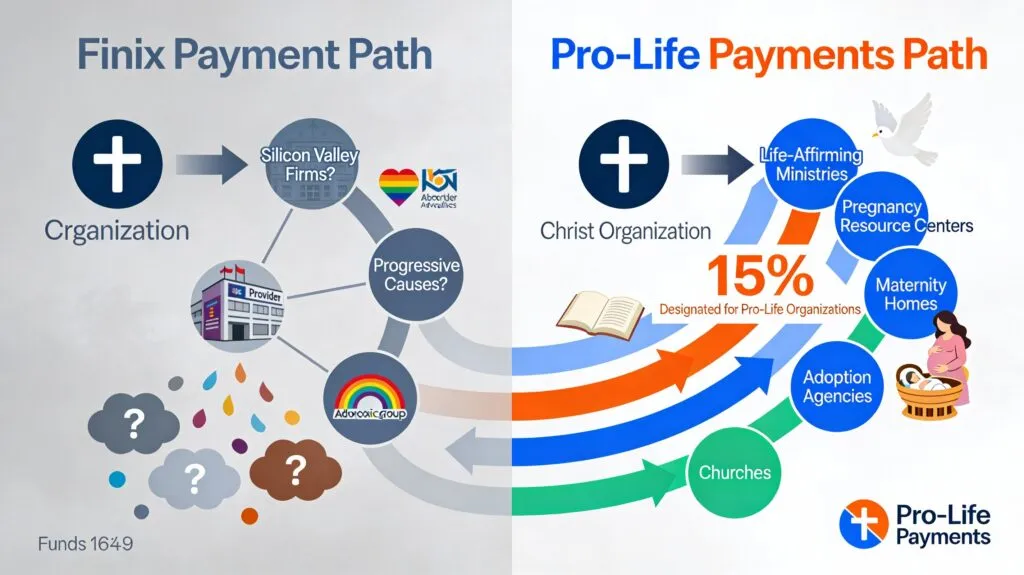
For organizations seeking Christian alternatives to Finix, several payment processors explicitly align with biblical values and pro-life causes. Pro-Life Payments, founded in 2021, represents the leading Christian alternative, offering e-commerce, omni-channel payments, Bluetooth card readers, and donation management software while donating 15% of gross revenue to pro-life organizations. Unlike Finix’s neutral stance, Pro-Life Payments actively works to reduce abortion in America by turning financial transactions into pro-life funding. The company provides month-to-month contracts with no termination fees, next-day funding, and competitive rates while ensuring that no customer is canceled for holding conservative Christian beliefs. Other alternatives include companies that have publicly committed to not funding abortion travel, not promoting gender ideology, and protecting religious freedom. These Christian payment processors understand that financial stewardship extends beyond efficiency to moral impact, ensuring that every transaction honors God and supports life-affirming ministries rather than potentially funding organizations that oppose Christian values.
Must See Also: Christian Alternative to Qgiv
Financial and Operational Considerations for Faith-Based Organizations
While Finix offers technical capabilities including 99.999% uptime, universal APIs, and support for multiple payment methods, Christian alternatives provide comparable services with added value for faith-based communities. Pro-Life Payments integrates e-commerce solutions, omni-channel payments, donation management software, and Bluetooth card readers with the crucial distinction that their platform never discriminates against Christian organizations for their biblical stance on marriage, sexuality, or life. The company’s commitment to donate 15% of revenue to pro-life causes means that using their service actively funds pregnancy resource centers, maternity homes, and adoption agencies rather than potentially supporting abortion providers or LGBTQ advocacy groups. For churches, pro-life pregnancy centers, Christian schools, and faith-based non-profits, this alignment transforms payment processing from a mere business utility into a ministry partnership. The technical capabilities match or exceed Finix’s offerings while providing peace of mind that your financial transactions are not inadvertently funding causes that violate Christian conscience.
Must See Also: Flexible Payment Solutions for Pro-Life Organizations
Risk Assessment and Due Diligence Recommendations
Christian organizations conducting due diligence on payment processors should require explicit answers to questions that Finix has not addressed publicly. Does the company provide abortion travel benefits? Does the company fund gender-transition procedures? Does the company have policies protecting employees with traditional Christian beliefs from discrimination? Does the company donate to or partner with Planned Parenthood, LGBTQ advocacy groups, or organizations promoting critical race theory? Finix’s public silence on these matters should be interpreted as a red flag requiring direct interrogation. The company’s Silicon Valley location, progressive investor base, and hiring from companies with known progressive activism create significant risk that Finix will eventually adopt the same social stances as its peer group. Christian organizations should demand written policies guaranteeing protection for religious viewpoints, commitment to not fund abortion or gender transition, and transparency about corporate giving. Without such explicit protections, Finix represents an unacceptable risk for ministries that cannot compromise on biblical values.
Must See Also: Ensuring Security and Trust with Conservative Payment Processing
Conclusion: Evaluating Finix Through a Biblical Lens
Based on comprehensive analysis of Finix’s corporate structure, leadership, public statements, and strategic positioning, the evidence strongly suggests that Finix does not share Christian, pro-life values. The company’s strategic silence on abortion, LGBTQ issues, and DEI—while potentially calculated to avoid controversy—reflects a secular worldview that prioritizes market positioning over moral clarity. In today’s cultural environment where major payment processors actively fund abortion travel and gender transitions, silence cannot be interpreted as neutrality but rather as acquiescence to the progressive status quo. Finix’s leadership pedigree from Google, Tesla, and Uber; its investor base from progressive Silicon Valley venture firms; and its location in one of America’s most socially liberal cities all indicate that the company would face immense internal and external pressure to adopt progressive social policies if challenged. For Christian organizations committed to pro-life principles and biblical sexuality, Finix fails to provide the transparency, values alignment, and moral leadership necessary for a trusted partnership. The search for Christian alternatives to Finix is not merely preferable but essential for faithful stewardship of financial resources and protection of religious freedom.
Must See Also: Christian PayPal Alternatives: Supporting Your Beliefs Through Secure Payments