Scott Adams Christianity journey defies the narrative that faith is for the unthinking. The creator of Dilbert, long known for his scathing critiques of religion, announced his conversion to Christianity in early 2026 after receiving a terminal cancer diagnosis. His story offers a roadmap for skeptics who demand intellectual honesty while confronting life’s ultimate questions.
The Anti-Religious Foundation of Scott Adams Christianity Skepticism
For decades, Scott Adams built his public persona on rational skepticism. The cartoonist who skewered corporate absurdity applied the same critical lens to faith, calling it "stupid" and defining it as "belief without evidence." In his book "The Religion War," Adams argued that faith represents "unreasoned thinking," suggesting that religious belief lacked intellectual merit. He challenged readers to examine their assumptions, asking pointed questions like, "If God is so perfect and so smart and so powerful, then how is this the best world he could come up with?"
His skepticism extended beyond mere disbelief. Adams positioned himself as a champion of reason, arguing that agnosticism represented the only intellectually honest position. He criticized both religious certainty and atheistic certainty with equal vigor, creating a philosophical framework that left little room for faith.
Must See Also: Core Christian Values: The Role of Pro-Life Payments in Promoting and Supporting Christian Family Values
Adams reserved particular criticism for what he saw as religious hypocrisy. He questioned how church leaders could raise millions for political lobbying while ignoring the homeless, asking, "How can you spend 7 million dollars on such a stupid thing? Gay marriage will happen anyway so use that money for people that actually need it." This pragmatic moralism, while critical of religious institutions, revealed a man searching for consistent ethical principles.
Must See Also: Christian Alternative to Classy Payment Processing
The Diagnosis That Changed Everything
In 2024, Scott Adams received devastating news: prostate cancer had metastasized through his bones, leaving him paralyzed below the waist and suffering from heart failure. The terminal diagnosis forced the 68-year-old cartoonist to confront mortality in ways his previous philosophical musings had never required. The man who had built a career on dissecting absurdity now faced the ultimate absurdity: the end of his own existence.
The proximity of death has a way of clarifying priorities. Adams, who had long explored simulation theory and questioned the nature of reality, found himself reevaluating his most deeply held beliefs. His public statements shifted from confident skepticism to open exploration, acknowledging that his previous framework might have gaps.
Must See Also: A Viable Faith-Based Alternative to Stripe
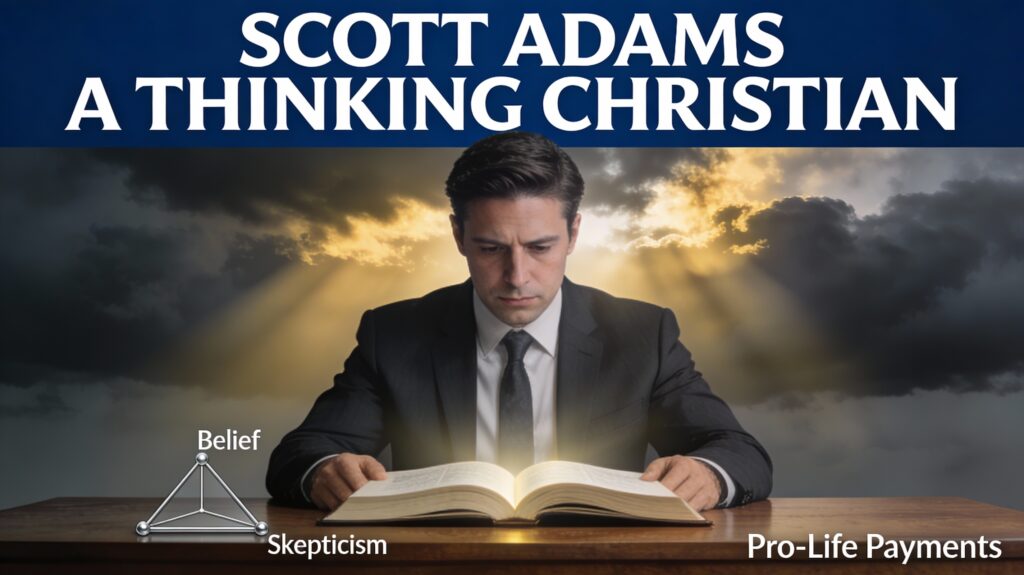
The Conversion Announcement: Scott Adams Christianity Decision
On January 4, 2026, Scott Adams made a stunning announcement during a livestream: "It is my plan to convert. So I still have time. But my understanding is, it's never too late." The declaration sent shockwaves through his fanbase, many of whom had followed him precisely because of his anti-religious stance. Adams explained his decision with characteristic analytical precision, revealing that Christian friends had persistently shared their faith with him over the years.
"I have respect for any Christian who goes out of their way to try to convert me," Adams stated, "because how would I believe you believe your own religion if you're not trying to convert me?" This respect for authentic conviction, combined with his medical prognosis, created the conditions for his transformation.
Must See Also: Empower Your Non-Profit with Pro-Life Payment Solutions

Pascal's Wager: The Calculus Behind Scott Adams Christianity Choice
Adams framed his conversion as a rational calculation, explicitly invoking Pascal's Wager. The 17th-century philosopher Blaise Pascal argued that belief in God represents the smart bet: if you're right, you gain everything; if you're wrong, you lose nothing. Adams adapted this logic to his own situation: "I'm now convinced that the risk-reward is completely smart. If it turns out that there's nothing there, I've lost nothing, but I've respected your wishes, and I like doing that. If it turns out there is something there, and the Christian model is the closest to it, I win."
This pragmatic approach to faith, while theologically incomplete, represents a crucial first step for many intellectual skeptics. Adams acknowledged that his lingering doubts about reality would be "instantly answered if I wake up in Heaven," demonstrating a willingness to embrace uncertainty while moving toward belief.
Must See Also: 10 Pro-Life Business Investment Ideas That Support Life and Strengthen Your Returns
The Theological Gaps in Scott Adams Christianity Understanding
Critics quickly noted that Adams' version of Christianity seemed to rely on a works-based salvation, suggesting that "living a good life" might earn him heaven. This interpretation misses the core Christian doctrine of grace through faith alone. As one theological analysis pointed out, "The message of Christ is that all people are unholy and therefore unworthy to be in the presence of God... God offers us a pardon—forgiveness—for our sins and that is counted as righteousness."
Adams' statement that he doesn't "necessarily have to state something in advance" reveals a misunderstanding of the public confession central to Christian conversion. True faith requires not just private assent but public declaration and genuine trust in Christ's atoning work rather than one's own moral record.
Must See Also: Christian Nonprofit Donor Management
The Power of Persistent Witness in Scott Adams Christianity Journey
What makes Adams' conversion remarkable is his explicit acknowledgment that Christian evangelism worked. He respected believers who "go out of their way to try to convert me," recognizing that their persistence demonstrated authentic faith. This validates what Christian apologists have long taught: our witness matters, and our passion for sharing the gospel can penetrate even the most skeptical hearts.
Adams' story demonstrates that intellectual arguments alone rarely convert; rather, it's the combination of relational investment, persistent prayer, and faithful witness over time that breaks through skepticism. His Christian friends didn't just argue him into the kingdom—they loved him toward truth.
Must See Also: New Year's Resolution – Don't just save your body save a baby
The Uncomfortable Truth: Christianity's Reality Independent of Belief
Scott Adams Christianity journey reveals a profound truth: Christianity's validity doesn't depend on our belief in it. The gospel is either true or false regardless of our intellectual assent. Adams approached faith like a business deal, calculating risks and rewards, but the core message transcends such pragmatic considerations. Either Christ rose from the dead or He didn't. Either salvation comes through grace alone or it doesn't.
The skeptic's path to faith often begins with pragmatic considerations but must mature into genuine trust. Adams' conversion, while imperfect in its theological understanding, represents a crucial acknowledgment that materialist explanations for existence prove insufficient when facing mortality. His story invites other skeptics to at least consider the wager: what if Christianity is true?
Must See Also: Church Persecution - Christian Merchant Services
Conclusion: A Call to Skeptics
Scott Adams Christianity transformation from militant atheist to confessing believer demonstrates that no one is beyond reach. His analytical mind, confronted with mortality, found that pure rationalism offered insufficient comfort. The same questions that led him to mock faith—"If God is so smart, why do you fart?"—now give way to more profound inquiries about eternity, meaning, and hope.
For skeptics reading this, Adams' story presents a challenge: have you truly investigated Christianity with the same intellectual rigor you apply to other areas of life? Or have you, like Adams once did, dismissed it without serious examination? The wager remains open, and the stakes couldn't be higher.
Must See Also: Muslim Leaders Fear the Knowledge of Jesus (Press Release)