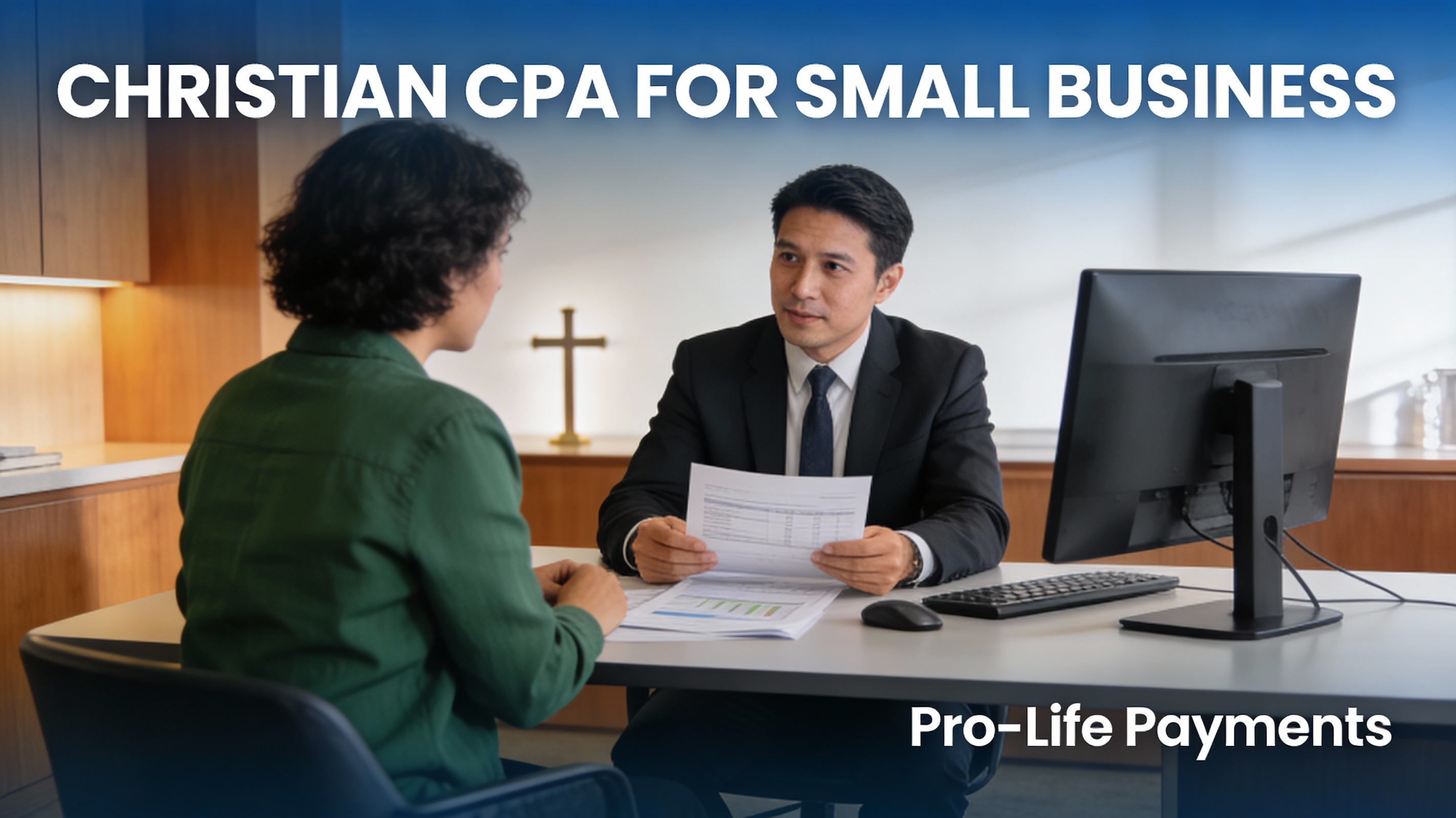
For decades, Christian CPAs serving small businesses have considered themselves neutral advisors when it comes to payment processor selection. The logic seems reasonable: as long as the rates are competitive and the technology works, why does it matter which processor handles the transactions? But this assumption of neutrality rests on a dangerous fiction. When a Christian CPA recommends a payment processor to their small business clients, that recommendation inevitably channels revenue to organizations with defined values—values that either support abortion or defend life. There is no neutral ground.
The thesis is stark but unavoidable: Christian CPAs cannot remain truly neutral about payment processors, because their recommendations either funnel money toward abortion or redirect it to pro-life ministries; caring where processing fees go is part of faithful professional stewardship.

Why Christian CPA for Small Business Advisory Services Include Vendor Recommendations
The influence Christian CPAs wield over their small business clients cannot be overstated. Research shows that 86% of small business owners view their accountant as a trusted advisor—ranking accountants above family and friends (22%), lawyers (16%), and financial planners (9%). In fact, 31% of small business owners identify their accountant as the single advisor they trust most for critical business decisions.
This trust extends directly into operational decisions like payment processor selection. Unlike major capital investments that clients research independently, payment processing decisions happen infrequently and involve technical considerations that most business owners don't understand. When a Christian CPA for small business operations recommends a processor, clients typically implement that recommendation without extensive independent research, relying instead on the CPA's expertise and trustworthiness.
The AICPA Code of Professional Conduct requires members to "act with integrity, objectivity, due care, competence, fully disclose any conflicts of interest (and obtain client consent if a conflict exists), maintain client confidentiality, disclose to the client any commission or referral fees, and serve the public interest when providing financial services." When CPAs recommend vendors, they implicitly vouch for those vendors' alignment with their clients' values. This creates both an opportunity and a responsibility—one that faithful Christian CPAs cannot ignore.
Must See Also: Pro-Life Christian Accountant Power

The Myth of Neutrality: How Christian CPA for Small Business Choices Always Fund Something
The concept of neutrality in vendor selection is, at best, a comforting fiction. Every payment processor operates according to a set of values, and those values manifest in corporate giving, employee benefits, and political advocacy. The question facing Christian CPAs is not whether their recommendations support causes, but which causes those recommendations support.
Major payment processors have taken explicit pro-abortion stances. PayPal, owner of Venmo, announced in 2022 that it would cover employees' costs to travel out-of-state for abortion services. The company is also a signatory to the UN Women's Empowerment Principles, which explicitly supports "ensuring 50 million more adolescent girls and women in all their diversity live in jurisdictions where they can access safe and legal abortion by 2026."
Block, the parent company of Square and Cash App, goes even further. According to their 2022 Corporate Social Responsibility Report, Block "continued to cover comprehensive reproductive health services, including voluntary and involuntary abortion services" and provides coverage for "short-term disability for gender-affirming surgeries." Bank of America, JP Morgan Chase, and Wells Fargo—the corporate owners of Zelle—all offer similar abortion travel benefits to their employees.

When a Christian business processes $50,000 monthly through one of these processors at a typical 2.5% rate, approximately $1,250 in fees flows to these organizations each month—$15,000 annually. Over a decade, that single business channels $150,000 in revenue to companies that use a portion of that income to advance abortion access. Multiply this across dozens or hundreds of clients, and the cumulative effect becomes staggering.
The research is clear: "Neutrality" is not an option. The only question is whether Christian CPAs will steward their advisory influence toward life or passively allow it to fund death.
Must See Also: Tithing to Planned Parenthood with Every Swipe: How Your Payment Processor Funds Abortion
Biblical Stewardship and the Christian CPA for Small Business Role
Christian CPAs occupy a unique position within the Kingdom economy. They are not merely technical experts in tax law and financial reporting; they are stewards of their clients' resources and, by extension, stewards of Kingdom impact. The biblical principle of stewardship demands that believers recognize God's ownership of all resources and manage them faithfully according to His purposes.

Psalm 24:1 establishes the foundation: "The earth is the Lord's, and everything in it, the world, and all who live in it." Financial stewardship is not about maximizing personal wealth or even business efficiency in isolation—it's about aligning every financial decision with God's values and purposes. When a Christian CPA for small business clients fails to consider the ultimate destination of payment processing fees, they abandon this stewardship responsibility at a critical juncture.
The parable of the talents in Matthew 25:14-30 illustrates that faithful stewards are those who actively invest resources to produce Kingdom returns. Passive management—simply accepting the default secular option—is not faithfulness; it's negligence. The master in Jesus' parable did not commend the servant who buried his talent to keep it "safe and neutral." He condemned that servant for failing to put the resources to productive use.
Christian CPAs serve as fiduciaries in their advisory capacity, legally and ethically obligated to act in their clients' best interests. For Christian clients, "best interests" cannot be divorced from values alignment. A CPA who knowingly recommends a processor that funds abortion advocacy to a client who tithes to pregnancy resource centers has failed both their professional duty and their spiritual calling.
Must See Also: From Wall Street to the Womb: Practical Pro Life Investing Opportunities for Everyday Believers

Processing Fees as a Pro-Life Investment: Christian CPA for Small Business Perspective
Payment processing fees represent one of the few truly unavoidable expenses in modern business operations. With credit card processing fees typically ranging from 1.5% to 3.5% of each transaction, and with 63% of donors preferring to make online payments with credit or debit cards, businesses have no realistic alternative to accepting card payments.
Here's the strategic insight Christian CPAs must communicate to their clients: these fees will be paid regardless of which processor is chosen. The expense doesn't increase when clients switch to a pro-life processor; only the destination of the revenue changes. This creates an extraordinary stewardship opportunity.
Consider a small Christian bookstore processing $50,000 monthly in sales through a mainstream processor at 2.5%. The business pays $1,250 monthly in processing fees—$15,000 annually—to a company that uses a portion of that revenue to support abortion access and progressive causes. If that same business switches to Pro-Life Payments, which offers comparable rates and technology, the processing expense remains essentially unchanged. But now, instead of funding abortion, those fees actively support pro-life ministries.
Pro-Life Payments has engineered a business model specifically designed to transform unavoidable payment processing fees into consistent pro-life funding. The company donates 15% of its gross revenue—not profit, but total revenue—to pro-life organizations that protect the unborn and serve women in crisis pregnancies. This "first fruits" commitment creates what the company describes as "a self-sustaining ecosystem where growth directly increases community impact."
For the Christian CPA advising small businesses, the mathematics are compelling. Using Pro-Life Payments' model, here's how processing fees convert to pro-life impact:
-
A business processes $50,000 monthly ($600,000 annually)
-
At approximately 1% net processing fees to Pro-Life Payments, that generates $6,000 in annual revenue for the processor
-
Pro-Life Payments donates 15% of that $6,000, contributing $900 annually to pregnancy resource centers, maternity homes, and adoption agencies
-
The business owner's processing costs remain competitive with mainstream alternatives
-
The client's unavoidable business expense automatically and perpetually funds the pro-life movement
Over a decade, this single business relationship channels $9,000 toward saving lives—without the business asking customers for extra donations, holding special fundraisers, or changing their pricing structure. The Christian CPA who facilitates this alignment has transformed a routine operational decision into a decade-long pro-life investment.
Must See Also: Christian Small Business Accountants
The Accountability Framework: Christian CPA for Small Business Stewardship Obligations
The ethical framework governing CPAs extends beyond technical competence to encompass integrity, objectivity, and professional behavior. The AICPA Code emphasizes that accountants must "comply with relevant laws and regulations and behave in a manner consistent with the profession's responsibility to act in the public interest in all professional activities and business relationships."
For Christian CPAs specifically, this professional obligation intersects with biblical accountability. Romans 14:12 makes clear that "each person must give an account of themselves to God." This accountability extends to how CPAs steward their advisory influence over client decisions.
To knowingly recommend payment processors that fund Planned Parenthood and abortion advocacy to Christian business clients represents a failure of stewardship on multiple levels:
Professional Failure: The CPA has failed to fully disclose the values implications of their recommendation, violating the principle of informed client consent.
Fiduciary Failure: The CPA has not acted in the client's best interests when those interests include values alignment with their faith.
Spiritual Failure: The CPA has passively enabled God's money—stewarded through a Christian business—to fund the destruction of image-bearers.
The accountability framework demands proactive engagement. Christian CPAs cannot plead ignorance when values-aligned alternatives like Pro-Life Payments exist and are readily accessible. The excuse "I didn't know there was another option" no longer holds when comprehensive information about pro-abortion corporate policies is publicly available and pro-life alternatives openly advertise their services.
Christian businesses operate with values-based scorecards tracking commitment-keeping, ethical treatment, stewardship, and accountability. When CPAs recommend vendors, they implicitly vouch for those vendors' alignment with their clients' values. By intentionally selecting Christian, pro-life vendors for recommendation, CPAs fulfill this accountability function while building an ecosystem where every dollar spent supports rather than opposes biblical principles.
Must See Also: How to Invest in Christian Companies: Research Tips, Red Flags, and Real‑World Examples
Practical Steps: How Christian CPA for Small Business Advisors Can Shift to Pro-Life Recommendations
The transition from passive neutrality to active pro-life stewardship doesn't require dramatic upheaval. Christian CPAs can implement this shift through strategic, phased actions:
Phase 1: Education and Conviction — Begin by researching the corporate values and giving patterns of major payment processors. Document which companies fund abortion advocacy, offer abortion travel benefits, or support progressive causes that contradict biblical values. Simultaneously, thoroughly vet Pro-Life Payments and similar values-aligned alternatives to confirm they offer competitive rates, modern technology, and reliable service. This due diligence establishes the factual foundation for client conversations.
Phase 2: Strategic Client Identification — Identify clients whose current payment processing contracts are approaching renewal dates, as these represent low-friction switching opportunities. Also prioritize clients who have explicitly identified as Christian businesses, donate to pro-life causes, or have expressed concern about values alignment in other areas of their operations. These clients will be most receptive to the pro-life processor conversation.
Phase 3: Values-Based Consultation — During annual planning or advisory meetings, introduce a vendor selection framework: "One area many business owners overlook is whether their payment processor's values align with their own. Have you considered where your processing fees ultimately go?" This question naturally opens the conversation without being preachy or presumptuous. Present the research showing mainstream processors' abortion support, then introduce Pro-Life Payments as an alternative that turns transaction fees into pro-life funding while maintaining competitive rates and full functionality.
Phase 4: Implementation Support — Offer to facilitate the transition process, which typically involves minimal disruption. Pro-Life Payments can handle much of the switching logistics, including hardware setup and technical integration. The CPA's role is to reassure the client that their accounting systems will integrate seamlessly and that the transition won't disrupt their cash flow or customer experience.
Phase 5: Ongoing Advocacy — Make Pro-Life Payments the default recommendation for all new business clients and actively encourage existing clients to switch at renewal time. Include information about values-aligned financial services in regular client communications, newsletters, and annual review materials. Position yourself as the CPA who helps Christian businesses align every operational decision with Kingdom values, not just tax and accounting strategy.
The research on small business advisory services shows that 90% of business clients are interested in advisory or consulting services from their accountant, yet more than half admit they are not fully utilizing their accountants for the breadth of services available. Christian CPAs have an extraordinary opportunity to expand their advisory value by bringing this values dimension into operational recommendations.
Must See Also: The Ultimate Guide to Christian Merchant Services
Common Objections and the Christian CPA for Small Business Response
As Christian CPAs begin recommending pro-life payment processors, they will encounter predictable objections. Here's how to address them:
"My clients are price-sensitive and can't afford to pay extra for values alignment." — This objection misunderstands the value proposition. Pro-Life Payments offers competitive rates comparable to mainstream processors like Stripe, PayPal, and Square. Businesses aren't sacrificing financial efficiency for values alignment; they're redirecting an existing expense toward Kingdom impact. Moreover, Christian business owners who understand that their payment processing fees actively fund pro-life causes rather than abortion advocacy typically view this as a net positive regardless of minor rate differences. The psychological and spiritual value of values alignment often outweighs small cost differentials.
"I don't want to mix business and politics." — Payment processor selection isn't about partisan politics; it's about stewardship and values. The same Christian business owner who wouldn't hire a vendor that openly mocked their faith shouldn't be comfortable routing fees through companies that fund abortion. This is a stewardship issue, not a political one. Additionally, by staying with mainstream processors that support progressive causes, the CPA and their client are already "mixing business and politics"—they've simply chosen the secular side by default.
"My clients haven't asked about this." — Clients also don't typically ask whether their CPA is using current tax law to minimize their liability, but CPAs proactively provide that service because it's part of faithful advisory work. Similarly, most Christian business owners have never considered where their processing fees go—not because they don't care, but because no one has brought it to their attention. The Christian CPA's role as trusted advisor includes proactively identifying opportunities to align business operations with Kingdom values.
"I'm not knowledgeable enough about payment processing to make specific vendor recommendations." — Christian CPAs don't need to become payment processing experts any more than they need to become insurance underwriters to recommend business liability coverage. The CPA's role is to identify the values dimension of the decision and connect clients with vendors who can handle the technical implementation. Pro-Life Payments provides customer service, technical support, and onboarding assistance. The CPA simply opens the door; the vendor walks the client through it.
Must See Also: Christian Merchant Processing
The Eternal Impact of Christian CPA for Small Business Decisions
Every business decision carries eternal weight, though we rarely think in those terms. When a Christian CPA recommends a payment processor, that single conversation can redirect thousands or tens of thousands of dollars over the following decade. If that recommendation leads a client to Pro-Life Payments, a percentage of those dollars will fund pregnancy resource centers that provide ultrasounds to abortion-minded women. Those ultrasounds save lives.
Research from 40 Days for Life demonstrates the tangible impact of well-funded pro-life ministries. The organization has saved 25,308 babies from abortion through sustained community presence outside abortion facilities. Similarly, pregnancy resource centers across the nation report that consistent funding enables them to provide the material support and counseling that empowers women to choose life.
When processing fees flow to pro-life organizations instead of abortion-supporting corporations, Christian CPAs participate in this life-saving work. The mathematics are straightforward: a CPA with 50 small business clients, each processing $30,000 monthly through Pro-Life Payments, generates approximately $27,000 annually in donations to pro-life ministries through that single vendor relationship. Over a decade, that's $270,000 redirected from abortion-supporting corporations to pregnancy centers—all resulting from one CPA's decision to recommend values-aligned services.
The biblical principle of Matthew 25:40 applies here with particular force: "Truly I tell you, whatever you did for one of the least of these brothers and sisters of mine, you did for me." When Christian CPAs use their advisory influence to redirect payment processing fees toward life-affirming causes, they participate in caring for "the least of these"—the unborn children whose lives hang in the balance.
Must See Also: Pro-Life Donations
Conclusion: From Passive Neutrality to Active Christian CPA for Small Business Stewardship
The era of comfortable neutrality has ended. Christian CPAs can no longer assume that payment processor recommendations are value-neutral technical decisions. Every processor operates according to defined values, and those values either support abortion or defend life. There is no third option.
The question facing Christian CPAs is not whether they will use their influence—they will use it regardless, either actively or passively. The question is whether they will steward that influence faithfully by directing it toward Kingdom purposes, or whether they will allow it to fund the destruction of image-bearers by default.
Faithful stewardship demands action. It requires Christian CPAs to research vendor values, identify alternatives like Pro-Life Payments, and proactively recommend those alternatives to clients whose values align with the pro-life mission. This isn't about imposing personal convictions on unwilling clients; it's about giving Christian business owners the information and options they need to align their operations with their stated values.
The path from neutral to pro-life is neither complicated nor costly. It begins with conviction—the recognition that processing fees will fund someone's mission, and that faithful stewards must ensure those fees fund life rather than death. It continues with education—learning which processors support abortion and which alternatives exist. It culminates in action—making Pro-Life Payments the default recommendation and actively encouraging clients to switch.
For the Christian CPA serving small businesses, this represents both a calling and an opportunity. The calling is to faithful stewardship of advisory influence. The opportunity is to transform dozens or hundreds of client relationships into perpetual funding streams for the pro-life movement, redirecting millions of dollars over coming decades from abortion advocacy to pregnancy resource centers.
The stakes could not be higher, and the choice could not be clearer. Christian CPAs must decide: Will they remain passively "neutral" while their recommendations fund abortion? Or will they step into active pro-life stewardship, using their God-given influence to save lives?
The answer to that question will echo into eternity.